COMPLIANCE & REGULATIONS
One sentence of NFPA 96 governs how often your kitchen exhaust system gets inspected — and one section governs when it needs cleaning. Most operators have heard “quarterly” or “every six months” and stopped there. The full rule is more useful, and it lives in Section 12.6.1.1 and Table 12.4 of the 2024 Edition.
July 21, 2026 · By Facilitec Southwest
The short version: NFPA 96 does not tell you to clean your hood on a fixed calendar. It tells you to inspect the exhaust system on a schedule that depends on how hard the kitchen is cooking, and to clean whenever the inspection reveals grease buildup that a qualified person considers a fire hazard. That’s a meaningful distinction most operators never hear.
This post walks through what Section 12.6.1.1 says, how Table 12.4 sets the inspection cadence, what “cleaned to bare metal” actually means in practice, and where operators commonly get the rule wrong. It’s written for the restaurant owner, facility manager, or corporate compliance lead who needs to know what the standard says and how to talk to their kitchen exhaust vendor about it.
QUICK DEFINITIONS, BEFORE WE GO FURTHER
NFPA 96 is the National Fire Protection Association’s Standard for Ventilation Control and Fire Protection of Commercial Cooking Operations. AHJ stands for Authority Having Jurisdiction — the local fire marshal or fire-code office with enforcement authority in your city or county. IKECA is the International Kitchen Exhaust Cleaning Association, the industry trade group that issues the CECS and CECI credentials. CECS is Certified Exhaust Cleaning Specialist — IKECA’s technician-level credential. CECI is Certified Exhaust Cleaning Inspector — IKECA’s inspector-level credential. Phil Ackland Training is a long-running industry training program that issues its own recognized certification for kitchen exhaust system inspection and cleaning. Certified Technician, capitalized in Facilitec Southwest usage, refers to a person holding one of these recognized credentials.
What Section 12.6.1.1 Actually Says
The 2024 Edition of NFPA 96 opens Section 12.6.1.1 with a single, specific requirement:
The entire exhaust system shall be inspected for grease buildup by a properly trained, qualified, and certified person(s) acceptable to the authority having jurisdiction and in accordance with Table 12.4.
Three parts of that sentence do most of the compliance work:
1. “The entire exhaust system”
Not just the hood canopy. Not just the visible surfaces. The entire exhaust system means the hood, filters, plenum, ductwork through opened access panels, exhaust fan, and rooftop discharge. Anything grease-laden vapor touches on its way from the cookline to the atmosphere.
This is why a “hood-only” cleaning quote at half the price of a full NFPA 96 service is not the same service. If the ductwork was not inspected and cleaned where required, the exhaust system was not inspected per Section 12.6.1.1.
2. “Properly trained, qualified, and certified”
Section 12.6.1 sets the qualification standard for whoever does the inspection. In practice, most authorities having jurisdiction (AHJs) — meaning your local fire marshal — accept technicians with recognized credentials: Phil Ackland Certified, IKECA CECS or CECI, and equivalent recognized programs. The certification of the person doing the work is what makes the inspection report legally defensible.
This is also why the person’s name appears on the service label and written report — accountability to the standard runs through a named, certified individual, not a company name.
3. “In accordance with Table 12.4”
Table 12.4 is where the cadence comes from. It sorts commercial cooking operations into four categories and sets the minimum inspection frequency for each.
| COOKING OPERATION | INSPECTION FREQUENCY |
|---|---|
| Solid-fuel cooking and 24-hour operations (hospitals, campus dining halls, casino resort kitchens) | Monthly |
| High-volume kitchens (steakhouses, fast-food, high-output restaurants) | Quarterly |
| Moderate-volume kitchens (standard restaurants, hotels) | Semiannually |
| Low-volume kitchens (churches, seasonal facilities, day cares) | Annually |
Table 12.4 tells you when the exhaust system has to be inspected. Whether it needs to be cleaned at that inspection is a separate determination made by the qualified person doing the inspection.
FIELD NOTE — THE CADENCE RULE IS A FLOOR, NOT A CEILING
Table 12.4 sets the minimum inspection frequency. Fire marshals across TX, OK, LA, NM, and AR will accept the table cadence as a baseline, but if a specific kitchen loads grease faster than the table anticipates — high-humidity markets, dust-loaded markets, fryer-dominant menus, gameday volume, gulf-coast salt-air corrosion on rooftop fans — a qualified inspector can shorten the cadence. That call happens on the report, in writing, and becomes part of the operator’s documented service history.
When Cleaning Is Actually Required
Section 12.6.1.1 sets the inspection requirement. Cleaning is triggered separately, and the language that governs it lives in Section 12.6.1.1 and the paragraphs that follow.
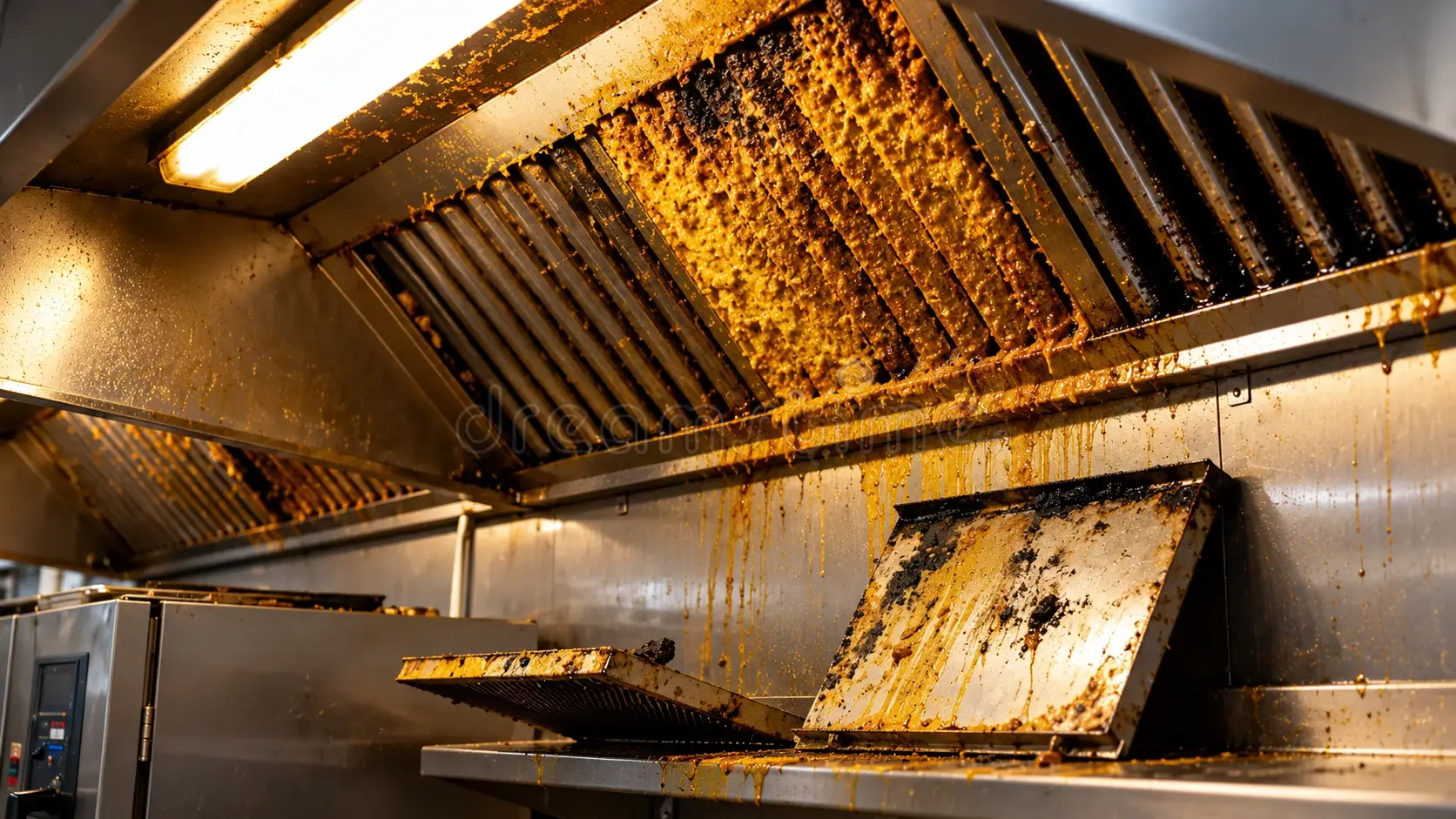
The rule the standard applies is straightforward: if the exhaust system is contaminated with combustible deposits, the contaminated portions must be cleaned by a qualified person. That’s not a calendar rule. That’s a condition rule. A hood that shows no grease buildup at inspection does not require cleaning that day. A hood that shows heavy grease buildup at a monthly inspection requires cleaning that day, regardless of what the calendar says.
What “combustible deposits” means in practice is where the industry has done a lot of work over the last decade. The standard does not set a specific micron measurement threshold that must be reached before cleaning becomes mandatory — the qualified inspector’s professional judgment is the trigger. That judgment is informed by:
- Visible grease accumulation on hood interior surfaces, plenum, and duct walls
- Depth of deposit measured against known combustion characteristics
- Location of accumulation (near fire suppression nozzles, near ignition sources, on the exhaust fan blades)
- Type of cooking operation and the flash characteristics of the specific grease
- Condition of the fire suppression system and its distance from combustible deposits
The “Bare Metal” Standard
When cleaning is required, Section 12.6.5 sets the outcome standard. After cleaning, the accessible portions of the exhaust system must be brought to a bare-metal condition — meaning no grease, no carbonized residue, no film. Not “wiped down.” Not “mostly clean.” Bare metal, capable of visual inspection.
This standard is why a Phil Ackland Certified cleaning takes longer than a wipe-down and why the price difference between a compliance-grade cleaning and a bargain “hood clean” reflects real work happening — not markup. Cleaning to bare metal at every accessible surface is what NFPA 96 actually requires, and it’s what a fire marshal expects to see when they run a hand across the plenum interior at inspection.
SIGNATURE PHRASE
From Cooktop to Rooftop, our Phil Ackland Certified Technicians clean to bare metal at every accessible surface NFPA 96 sets thresholds for. The outcome is a Grease-Free and Fire-Safe kitchen and the peace of mind that comes with it.
What “Accessible” Means Under Section 12.6.4
The accessibility rule is where a lot of vendor confusion — and a lot of failed inspections — comes from. Section 12.6.4 requires that the entire exhaust system be accessible for inspection and cleaning. That means access panels at the required intervals, hood plenums that can be opened, and ductwork that can be entered where physical access is possible.
Where access panels do not exist, they must be installed to bring the system into compliance. This is a requirement operators sometimes push back on because it involves cutting into existing ductwork — but the alternative is a system that cannot be inspected per Section 12.6.1.1, which means it cannot be cleaned per Section 12.6.5, which means it fails inspection.
The Hinge Kit Rule
Section 8.1.1.1 requires that exhaust fans on grease-laden duct systems be equipped with hinge kits. The hinge kit allows the fan housing to be swung open for access to the interior, the fan blades, and the top of the ductwork below. Without a hinge kit, the fan cannot be inspected or cleaned per the standard. A fan that has never been hinged and has never been opened for internal inspection is a compliance gap on any operator’s exhaust system.
The Access Panel Tag Rule
Section 12.6.10 requires that every access panel opened during service be tagged with the name of the servicing company, the date of service, and the areas cleaned. When a fire marshal walks a rooftop or a ceiling void and finds duct access panels with no service tags, that’s a documented compliance failure — the panels were installed for inspection access, but the inspection either never happened or was never documented.
The Documentation Chain
Three documents make up the NFPA 96 documentation chain that satisfies most fire marshal reviews and insurance underwriters:
| DOCUMENT | REQUIRED BY | WHAT IT CONTAINS |
|---|---|---|
| Service label on the hood | Section 12.6.13 | Company name, technician name, date of last cleaning, date of next scheduled service, areas not cleaned |
| Service tags at every opened access panel | Section 12.6.10 | Company name, date of service, areas cleaned through that panel |
| Written cleaning report | Section 12.6.15 | Delivered inside two weeks — full inspection findings, cleaning performed, areas requiring repair or attention, next-service recommendation |
An operator who can produce all three at inspection is meeting the standard’s documentation chain. An operator missing any one of them has a gap the fire marshal will note and the insurance underwriter will flag at renewal.
See our detailed explainer on the service label and written report requirements for what each document should actually contain.
Five Common Misconceptions
1. “Quarterly cleaning is the rule.”
Table 12.4 sets quarterly inspection for high-volume kitchens. Cleaning happens when the inspection finds a condition that requires it. Many high-volume kitchens will need cleaning at every quarterly inspection — but the trigger is the inspection finding, not the calendar.
2. “The hood looks clean, so we’re fine.”
The hood canopy is the smallest part of the exhaust system by surface area. Grease buildup that matters for fire risk usually appears in the plenum, the duct walls, and on the exhaust fan blades — all of which are hidden from a visual walk-through of the kitchen. A hood that “looks clean” from the cook’s side may have significant plenum accumulation.
3. “Our filters are new, so we don’t need service.”
Grease filters capture some airborne grease — but capture efficiency is imperfect, and the exhaust system loads regardless of filter condition. Daily filter cleaning is the kitchen’s responsibility under NFPA 96 and reduces load on the rest of the system, but it does not eliminate the requirement for scheduled inspection.
4. “We had a hood cleaning last month.”
A hood cleaning that did not include access panel entry, ductwork inspection, and fan interior work is not a compliant NFPA 96 service. The service label and written report will tell you what was and wasn’t cleaned — if the report says “hood interior only” or the fan interior was not accessed, the system has not been serviced per the standard.
5. “The AHJ hasn’t cited us, so we’re compliant.”
Fire marshals do not inspect every kitchen every year. Absence of citation does not equal compliance — it often just means the inspection has not happened yet. Insurance underwriters, on the other hand, look at documentation at every renewal. An operator with a clean fire-marshal record and no NFPA 96 documentation is one claim away from a coverage dispute.
FIELD NOTE — THE INSURANCE ANGLE
Insurance underwriters and loss-control representatives increasingly ask for NFPA 96 documentation at renewal — not because the fire marshal required it, but because a documented cleaning history is the single strongest predictor of low fire loss on their book. A kitchen with three years of documented Phil Ackland Certified cleaning on schedule presents differently to an underwriter than one with three years of undocumented vendor visits. That’s why the insurance documentation file matters even when the fire marshal is not asking.
What This Means in Practice
The practical answer to “how often should we clean our hoods” is: as often as the inspection determines is necessary, on a cadence that starts with Table 12.4 and adjusts to your kitchen’s actual grease loading. For most operators in TX, OK, LA, NM, and AR, that works out to:
- 24-hour operations (hospitals, campus dining, casino resorts): monthly inspection, cleaning most visits
- High-volume restaurants, hotels, chain operators: quarterly inspection, cleaning typically each visit
- Moderate-volume operators: semiannual inspection, cleaning at most visits
- Low-volume operators (churches, day cares, seasonal facilities): annual inspection, cleaning when the report requires it
The cadence gets tighter, not looser, when local conditions demand it: Gulf Coast humidity, Chihuahuan Desert dust loading, fryer-dominant Cajun and Creole kitchens, SEC gameday volume surges, and 24-hour shift-work traffic all shorten the interval for the specific operators exposed to them. A qualified inspector documents the reason on the report.
What matters at inspection is the documentation chain — the service label, the access-panel tags, and the written report delivered inside two weeks. If those three documents exist and match Table 12.4 for your operation, you’re meeting the standard.
Frequently Asked Questions
What does NFPA 96 Section 12.6.1.1 actually require?
Section 12.6.1.1 requires that the entire exhaust system be inspected for grease buildup by a properly trained, qualified, and certified person acceptable to the authority having jurisdiction, on a cadence set by Table 12.4. It sets the inspection requirement — cleaning is triggered when the inspection reveals combustible deposits.
Does NFPA 96 set a specific grease thickness threshold?
The standard does not set a fixed micron measurement that must be reached before cleaning is required. The trigger is the qualified inspector’s professional judgment that combustible deposits are present. That judgment is informed by visible accumulation, deposit depth, location relative to ignition sources and fire suppression nozzles, and the type of cooking operation.
How often should our exhaust system be inspected?
Table 12.4 sets the minimum cadence: monthly for solid-fuel and 24-hour operations, quarterly for high-volume kitchens, semiannually for moderate-volume restaurants, and annually for low-volume operations. Local conditions like humidity, dust loading, and gameday volume surges can shorten the interval on a qualified inspector’s recommendation.
What does “cleaned to bare metal” mean?
Section 12.6.5 sets the outcome standard for cleaning. Accessible surfaces of the exhaust system must be brought to a bare-metal condition — no grease, no carbonized residue, no film. Not “wiped down.” The surface must be capable of visual inspection.
What if part of our exhaust system isn’t accessible?
Section 12.6.4 requires that the entire exhaust system be accessible for inspection and cleaning. Where access panels don’t exist, they must be installed. Where an exhaust fan can’t be opened for interior access, a hinge kit must be added under Section 8.1.1.1. Areas that remain inaccessible after these steps must be noted on the service label so the AHJ knows the system’s compliance limits.
What documentation should we keep after each service?
Three items: the service label on the hood (Section 12.6.13) with company name, technician name, date, and next-service date; the service tags at every opened access panel (Section 12.6.10); and the written cleaning report (Section 12.6.15) delivered inside two weeks. Together these form the documentation chain a fire marshal and an insurance underwriter both expect to see.
Can our kitchen staff handle hood cleaning to save money?
No. Section 12.6.1 requires the inspection and cleaning be performed by a properly trained, qualified, and certified person acceptable to the AHJ. In-house staff without recognized certification do not satisfy the qualification requirement. See our companion post on DIY vs professional hood cleaning.
Who is the “authority having jurisdiction” (AHJ) for our kitchen?
For most commercial kitchens, the AHJ is the local fire marshal or fire prevention division of the city or county where the kitchen operates. State fire marshal offices set state-level requirements for certain operator categories, and DoD standards apply on military installations. Insurance carriers can also function as an AHJ for their own coverage decisions.
What happens if we fail a fire marshal inspection?
Typically a deficiency notice with a reinspection date. See our post on what happens after a failed fire marshal inspection for the step-by-step response.
NFPA 96, 2024 Edition — Section 12.6.1 (qualified-person rule); Section 12.6.1.1 (inspection requirement for grease buildup); Table 12.4 (inspection frequency by cooking operation); Section 12.6.4 (accessibility of exhaust system); Section 12.6.5 (cleaning to bare metal); Section 8.1.1.1 (exhaust fan hinge kit requirement); Section 12.6.10 (access panel service tags); Section 12.6.13 (service label content); Section 12.6.15 (written cleaning report). IKECA references are to the International Kitchen Exhaust Cleaning Association’s CECS (Certified Exhaust Cleaning Specialist) and CECI (Certified Exhaust Cleaning Inspector) credentials, and ANSI/IKECA C10 industry standard. Phil Ackland Training is an internationally recognized training program for kitchen exhaust system inspection and cleaning. Verification procedures reflect standard industry practice. Facilitec Southwest holds Phil Ackland Certification for its technicians and follows NFPA 96 guidelines for cleaning and inspection of grease buildup. This article is a compliance reference, not legal or AHJ-specific advice.