OPERATIONS & REGULATIONS · SECTION 8.1.1.1
Of every deficiency a fire marshal writes on a commercial kitchen rooftop, a missing hinge kit is the one operators most often haven’t heard of before the citation. It’s a small piece of hardware — a hinge, a cable, a prop — bolted to the base of the exhaust fan. Without it, the fan can’t be opened, which means the inside can’t be inspected, which means it can’t be cleaned to bare metal, which means the system fails NFPA 96 regardless of how clean the hood looks from the kitchen.
September 24, 2026 · By Facilitec Southwest
QUICK ANSWER
NFPA 96 Section 8.1.1.1 requires that approved upblast exhaust fans with motors in the airstream be hinged, supplied with a flexible weatherproof electrical cable, and fitted with a service hold-open retainer — collectively called a hinge kit. The hinge lets the fan tilt away from the duct opening; the flexible cable lets it tilt without disconnecting power; the hold-open retainer props it safely while a technician works. Together they make the fan interior, the fan wheel, and the top of the duct accessible for the inspection Section 12.6.1.1 requires and the bare-metal cleaning Section 12.6.5 requires. A fan without a hinge kit is inaccessible under Section 12.6.4 and cannot be brought into compliance by cleaning alone. Retrofit kits are available for most commercial upblast fans and are installed in a single rooftop visit.
HINGE KIT SURVEY AND RETROFIT
Facilitec Southwest checks hinge kit presence and condition on every rooftop visit, installs retrofit kits where Section 8.1.1.1 requires them, and documents the result on the written report.
See Our Exhaust Fan Service →
1. What a Hinge Kit Actually Is
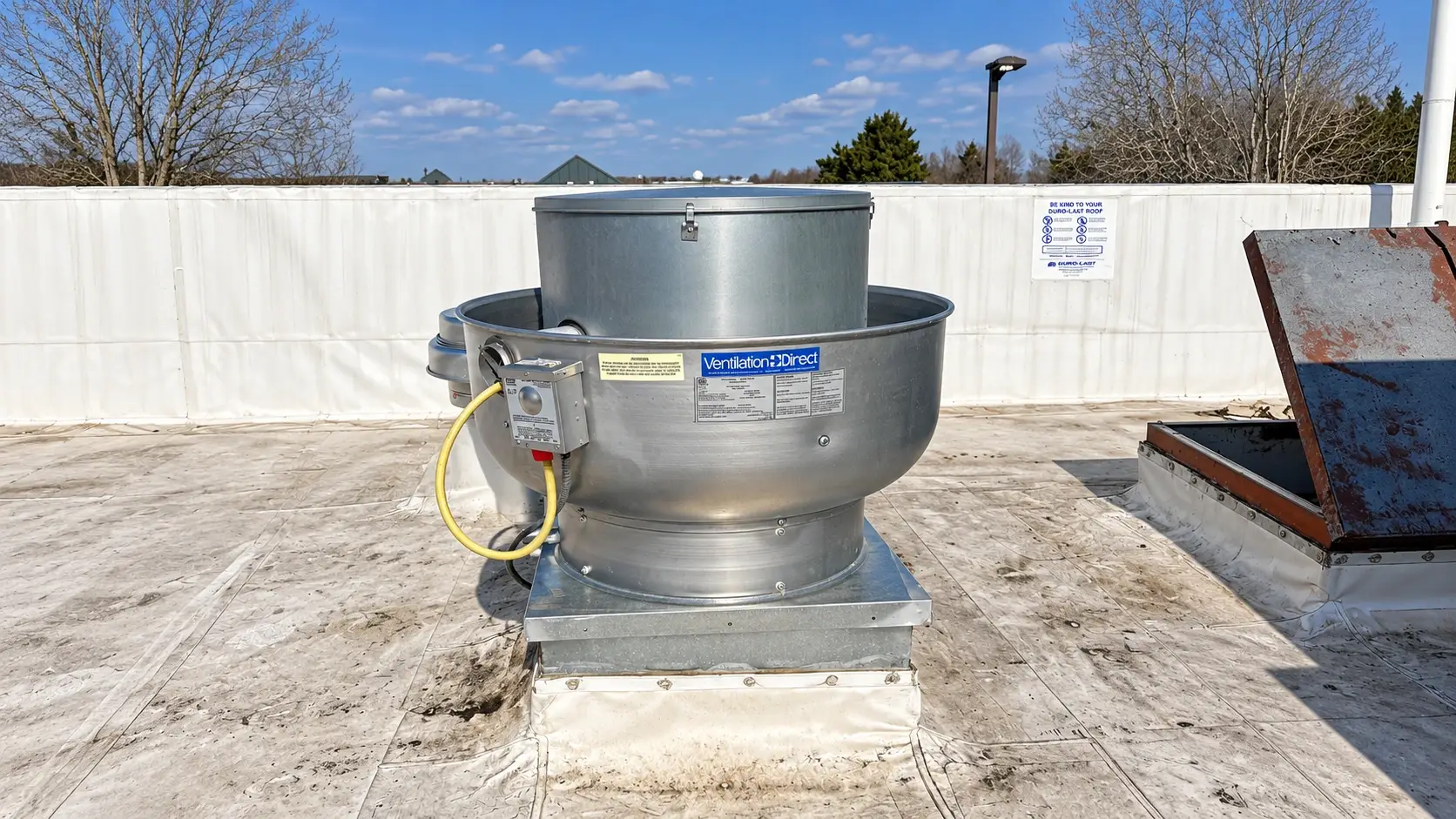
A commercial kitchen exhaust fan sits on a curb on the roof, bolted down over the top of the duct. The fan housing — a mushroom-shaped or square box, typically 24 to 48 inches across — contains the motor and the fan wheel. Grease-laden air comes up the duct, through the wheel, and out the top.
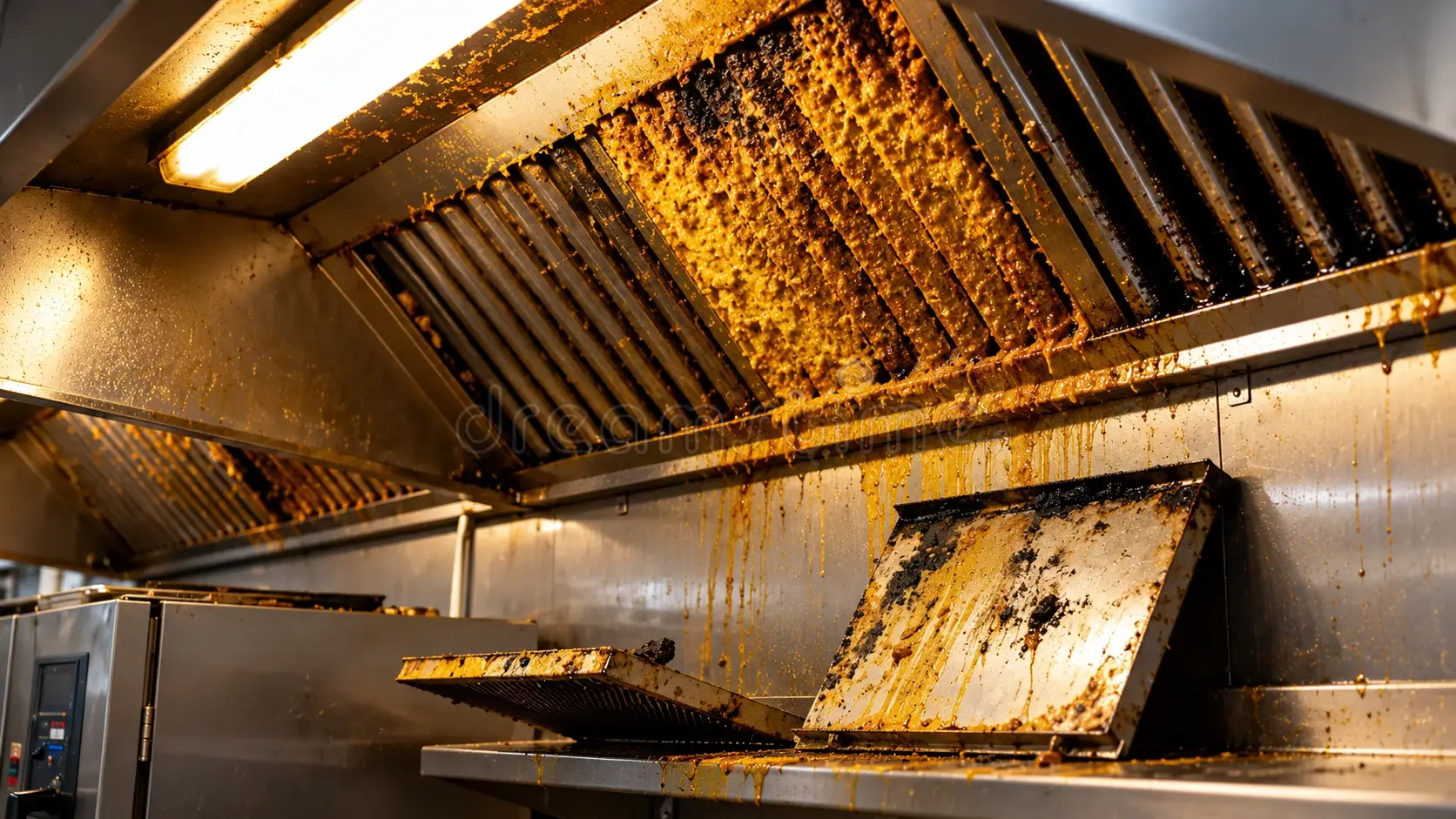
Every surface inside that housing accumulates grease: the wheel blades, the housing interior, the motor mount, the drain. NFPA 96 Section 12.6.5 says those surfaces have to be cleaned to bare metal. To clean them, a technician has to get inside. On a fan bolted flat to the curb, there is no way in — the only opening is the duct connection underneath, and that’s the duct.
A hinge kit solves this with three components:
| The hinge | The flexible electrical cable | The hold-open retainer |
|---|---|---|
| Heavy-gauge steel hinge assembly mounted between the fan base and the curb on one side. Lets the entire fan tilt up and away from the duct opening like a lid. | A weatherproof service loop of cable between the disconnect and the motor, long enough that the fan can tilt fully open without stressing or disconnecting the wiring. | A prop rod, gas strut, or locking arm that holds the fan in the open position while a technician works underneath it. Prevents the fan from falling closed. |
With all three installed, a technician disconnects power, tilts the fan open, locks the retainer, and has clear access to the fan wheel, the housing interior, the grease drain, and the top of the vertical duct. Without them, none of that is reachable.
IN ONE SENTENCE
The hinge kit is what turns the exhaust fan from a sealed box into a serviceable component. No hinge kit, no access. No access, no cleaning. No cleaning, no compliance.
2. What Section 8.1.1.1 Says
NFPA 96, 2024 Edition addresses hinge kits in Chapter 8, which covers exhaust fans and termination. Section 8.1.1.1 applies to upblast fans — the standard configuration for commercial kitchen exhaust — whose motors sit in the exhaust airstream. The requirement has three parts, each corresponding to one component of the kit:
- The fan shall be hinged. It must be capable of being tilted open to expose the interior and the duct connection.
- It shall be supplied with flexible weatherproof electrical cable. The power connection must allow the fan to tilt fully without disconnection or damage to the wiring.
- It shall have service hold-open retainers. Something must hold the fan in the open position during service.
The section also requires the fan to be listed for this use — meaning the fan manufacturer’s UL listing accounts for the hinged configuration. Most commercial upblast fans sold in the last two decades are listed with hinge kits as a factory option or approved retrofit.
Why It Lives in Chapter 8, Not Chapter 12
Chapter 12 is the maintenance chapter — inspection cadence, cleaning outcome, documentation. Chapter 8 is the equipment chapter — what the exhaust fan has to be. The hinge kit is a construction requirement: the fan has to be built or retrofitted this way. But its purpose is entirely in service of Chapter 12. Section 12.6.4 requires the entire exhaust system to be accessible for inspection and cleaning. On the fan, Section 8.1.1.1 is how that accessibility gets delivered.
Our post on the NFPA 96 access panel rule covers the same accessibility requirement as it applies to ductwork. Access panels make the duct reachable. The hinge kit makes the fan reachable. Both exist because of Section 12.6.4.
3. Why the Fan Interior Matters for Fire Risk
Operators sometimes ask why the fan — the last component before the air leaves the building — gets this much attention. Three reasons.
The fan wheel is where grease concentrates
Aerosolized grease that made it past the filters and through the duct hits the fan wheel blades at high velocity. The blades act as a final impingement surface. On a fan that hasn’t been opened in years, the blades carry a thick, uneven coating that also throws the wheel out of balance — which is why bearing and motor failures cluster on uncleaned fans. See our post on exhaust fan repair vs. replace.
The fan housing is the highest point of the fire path
A grease fire that travels up the duct reaches the fan. Fan housings are not built to contain fire the way Chapter 7 duct is. A fire that reaches a grease-loaded fan housing has fuel, a metal shell that conducts heat to the roof deck, and an open top. This is the point where a duct fire becomes a roof fire. Our post on grease duct fires covers the progression.
The motor is an ignition source
On upblast fans with motors in the airstream — which is exactly the configuration Section 8.1.1.1 addresses — the motor runs inside the grease-laden air. A motor that overheats from bearing drag, or that arcs from a failing winding, is an ignition source sitting in fuel. Regular interior cleaning removes the fuel from around it.
FIELD NOTE — THE FAN NOBODY HAS OPENED
Phil Ackland Certified Technicians doing a first-time survey on an established restaurant routinely find fans with no hinge kit that have been “cleaned” quarterly for a decade — by vendors who cleaned the hood, opened whatever duct panels existed, and stopped at the fan because they couldn’t get into it. The service labels say cleaned. The written reports say cleaned. The fan interior has never been touched. When the hinge kit finally goes on and the fan tilts open for the first time, the accumulation inside is measured in inches. That’s the fuel load the whole system was carrying while the paperwork said compliant.
4. What Happens Without One
A fan without a hinge kit produces a cascade of compliance failures, each one following from the last.
| WHAT FAILS | NFPA 96 SECTION |
|---|---|
| Fan cannot be tilted open | 8.1.1.1 — hinge requirement |
| Fan interior is not accessible | 12.6.4 — entire system shall be accessible |
| Fan interior cannot be inspected on the Table 12.4 cadence | 12.6.1.1 — entire system shall be inspected |
| Fan interior cannot be cleaned to bare metal | 12.6.5 — accessible portions cleaned to bare metal |
| Service label must note the fan as an area not cleaned | 12.6.13 — label shall indicate areas not cleaned |
| Written report must flag the deficiency | 12.6.15 — report shall note areas requiring attention |
| Fire marshal cites the operator | Local AHJ enforcement of 8.1.1.1 and 12.6.4 |
Step 5 is the one that catches honest vendors and honest operators alike. A vendor who can’t open the fan is required to say so on the label. An operator who reads the label sees “exhaust fan — inaccessible, hinge kit required.” That’s the correct, compliant behavior for a vendor facing a fan without a kit — and it’s also a written admission on the hood that the system isn’t fully compliant. The only way to clear it is to install the kit.
Vendors who skip step 5 — who label the system as fully cleaned when the fan was never opened — create a worse problem. The label is now inaccurate, and the fire marshal who tilts the fan (or tries to) finds out.
5. Which Fans Need One
Section 8.1.1.1 applies to upblast fans with motors surrounded by the airstream. That describes the large majority of commercial kitchen exhaust fans in the Southwest — the mushroom-shaped or square-housing rooftop units where the motor sits inside the housing and grease-laden air moves around it.
| FAN TYPE | HINGE KIT REQUIRED? | NOTES |
|---|---|---|
| Upblast centrifugal, motor in airstream | Yes | The standard commercial kitchen fan. Section 8.1.1.1 applies directly. |
| Upblast centrifugal, belt-drive with motor outside airstream | Access required; hinge typical | Motor is out of the grease path, but the wheel and housing still need bare-metal access. Most manufacturers supply hinged bases regardless. |
| Utility set fan (inline, side-mounted) | Access panel instead | Different geometry. Accessibility satisfied by housing access doors per 12.6.4. |
| Downblast fan | Not permitted on grease duct | Downblast fans discharge toward the roof and are not approved for grease-laden exhaust under Chapter 8. |
If your fan is the common mushroom-cap or square-box rooftop unit, it needs a hinge kit. If you’re not sure what type you have, the written report from a Phil Ackland Certified survey will identify it.
6. The Retrofit — What It Involves
Most fans built in the last twenty years either came with a factory hinge kit or have a manufacturer-approved retrofit kit available. Older fans and off-brand units may need a universal retrofit kit. Either way, installation is a single rooftop visit.
- Identify the fan. Make, model, base dimensions, curb type. This determines whether a manufacturer-specific or universal kit is used.
- Disconnect and verify power. The fan’s electrical disconnect is opened and locked out. A licensed electrician is involved if the existing wiring needs to be rerouted for the flexible service loop.
- Mount the hinge. The hinge assembly is bolted to the fan base and the curb on one side — typically the side opposite the electrical connection, so the cable has room to flex.
- Install the flexible cable. The rigid conduit connection is replaced with a weatherproof flexible service loop long enough for full tilt. This is the step that most often requires an electrician.
- Install the hold-open retainer. A prop rod, gas strut, or locking arm is mounted so the fan can be held safely open at full tilt.
- Test the tilt. Fan is tilted open, retainer engaged, cable checked for strain, then closed and re-secured.
- Clean the fan interior. Now that it’s open, the wheel, housing, and drain are cleaned to bare metal for the first time — often the heaviest single cleaning task in the visit.
- Document. The retrofit is recorded on the written report with photographs. The service label no longer lists the fan as inaccessible.
Facilitec Southwest handles steps 1, 3, 5, 6, 7, and 8 as part of the exhaust fan service scope. Step 4 — rerouting the electrical connection — is coordinated with a licensed electrician when the existing wiring doesn’t already accommodate a flexible loop. Cleaning vendors don’t do electrical work; the hand-off is documented.
SIGNATURE APPROACH
From Cooktop to Rooftop, our Phil Ackland Certified Technicians check the hinge kit on every fan, every visit. Where one is missing, we install it, open the fan, and bring the interior to bare metal — then photograph it for the written report so the operator and the fire marshal both see what was inside. The outcome is a Grease-Free and Fire-Safe kitchen all the way to the top of the system.
7. What the Fire Marshal Checks
Rooftop inspection of the exhaust fan is quick when the marshal knows what to look for. Four items, in order.
- Is there a hinge? Visual check of the fan base. A hinged fan has a visible hinge assembly on one side and a gap or seam on the other three where it lifts. A fan bolted flat on all four sides has no kit.
- Is the electrical connection flexible? Rigid conduit running straight into the housing means the fan can’t tilt without disconnecting. A visible service loop of flexible weatherproof cable means it can.
- Is there a hold-open device? Prop rod, strut, or arm mounted to the base or housing.
- Does the fan interior match the service label? The marshal may tilt the fan open — or ask the operator to have it opened — and shine a flashlight on the wheel. If the label says cleaned and the wheel is coated, the label is wrong. If the label says “fan inaccessible,” the marshal writes the hinge kit deficiency.
Marshals in TX, OK, LA, NM, and AR write this deficiency often enough that it’s one of the first items on most rooftop checklists. Our post on what fire and health inspectors look for covers the full walkthrough.
FIELD NOTE — THE RETAINER NOBODY USES
The hinge and the cable get installed. The hold-open retainer sometimes gets skipped or lost — a prop rod that was never mounted, a gas strut that failed, a locking arm that rusted. The fan still tilts, so the vendor tilts it and props it with whatever’s on the roof. That’s a technician-safety problem first — a 200-pound fan falling closed on someone working under it — and a Section 8.1.1.1 deficiency second. A complete hinge kit has all three parts working.
8. Hinge Kit and Grease Containment — Two Things on the Same Curb
The hinge kit and the rooftop grease containment system both mount at the fan base, and they have to work together.
A containment system — the absorbent pad or reservoir that catches grease draining from the fan — sits around or below the fan curb. A hinge kit tilts the fan up and away from the curb. If the containment was installed without accounting for the hinge, the fan can’t tilt without hitting it. If the hinge was retrofitted without accounting for the containment, the fan’s grease drain may no longer line up with the collection point.
On a properly designed installation, the fan tilts clear of the containment, and when it closes, the drain lands where the containment expects it. Our post on rooftop grease containment covers the containment side. When Facilitec Southwest installs either one, we check the other.
Frequently Asked Questions
What is a hinge kit on a kitchen exhaust fan?
A hinge kit is three components — a hinge assembly, a flexible weatherproof electrical cable, and a hold-open retainer — installed at the base of a rooftop upblast exhaust fan so the fan can be tilted open for inspection and cleaning. NFPA 96 Section 8.1.1.1 requires all three on upblast fans with motors in the airstream.
Why does NFPA 96 require a hinge kit?
Because the fan interior — wheel, housing, drain, and the top of the duct — accumulates grease and must be inspected per Section 12.6.1.1 and cleaned to bare metal per Section 12.6.5. Section 12.6.4 requires the entire exhaust system to be accessible. On the fan, the hinge kit is how that access is provided. Without it, the fan interior is unreachable and the system can’t be brought into compliance.
How do I know if my fan has a hinge kit?
Look at the fan base on the roof. A hinged fan has a visible hinge assembly along one side and a seam on the other three sides where it lifts. The electrical connection is a flexible cable loop, not rigid conduit. There’s a prop rod, strut, or arm mounted nearby. A fan bolted flat on all four sides with rigid conduit has no kit. Your NFPA 96 written report should also state it.
Can a hinge kit be added to an existing fan?
Yes, in almost all cases. Most fans built in the last twenty years have a manufacturer retrofit kit. Older or off-brand fans use universal kits. Installation is a single rooftop visit. The only common complication is rerouting the electrical connection from rigid conduit to a flexible service loop, which involves a licensed electrician.
What does the “flexible weatherproof electrical cable” requirement mean?
The power connection to the fan motor must be a flexible cable with enough slack that the fan can tilt fully open without stressing, pulling, or disconnecting the wiring — and it must be rated for outdoor exposure. Rigid conduit straight into the housing doesn’t allow tilt and doesn’t satisfy Section 8.1.1.1.
What is the “service hold-open retainer”?
A prop rod, gas strut, or locking arm that holds the tilted fan in the open position while a technician works underneath it. It’s a safety component — it prevents a heavy fan from falling closed — and it’s the third required element of the hinge kit under Section 8.1.1.1. A kit with a hinge and cable but no retainer is incomplete.
Does the hinge kit affect the grease containment system?
They share the fan curb and have to be compatible. The fan must tilt clear of the containment, and the fan’s grease drain must align with the collection point when closed. When either is installed or retrofitted, the other should be checked.
My vendor says they’ve been cleaning the fan for years — do I still need a hinge kit?
If the fan has no hinge kit, the interior has not been cleaned to bare metal — there’s no way to reach it. Ask to see the written report’s fan section and photographs of the fan wheel. If neither exists, the fan hasn’t been opened. Our post on cleaned to bare metal covers how to verify.
How does Facilitec Southwest handle hinge kits?
Phil Ackland Certified Technicians check hinge kit presence and condition on every rooftop visit. Where one is missing, we install the retrofit, coordinate with a licensed electrician if the wiring needs a flexible loop, open the fan, clean the interior to bare metal, and photograph the result on the written report. See our exhaust fan service.
NFPA 96, 2024 Edition — Section 12.6.1 (qualified-person rule); Section 12.6.1.1 (inspection requirement); Table 12.4 (inspection frequency); Section 12.6.4 (accessibility); Section 12.6.5 (cleaning to bare metal); Section 8.1.1.1 (exhaust fan hinge kit); Section 12.6.10 (access panel service tags); Section 12.6.13 (service label); Section 12.6.15 (written cleaning report); Chapter 10 (fire-extinguishing equipment). Reopening timelines reflect industry-typical experience across commercial kitchen fires in TX, OK, LA, NM, and AR and vary with fire severity, damage scope, AHJ workload, vendor availability, parts lead time, and insurance claim complexity. Fire marshal investigation and release procedures vary by jurisdiction. Fire suppression system references reflect standard wet-chemical system design (Ansul R-102 and equivalent Class K suppression); recharge and recertification requirements are governed by NFPA 17A and the manufacturer’s listing. Insurance notice requirements, claim procedures, and post-claim underwriting outcomes vary by carrier and policy. Ductwork fabrication and replacement, roof repair, and structural work are performed by licensed mechanical, roofing, and general contractors respectively; exhaust cleaning vendors clean, assess, and document but do not fabricate. IKECA references are to the International Kitchen Exhaust Cleaning Association’s CECS (Certified Exhaust Cleaning Specialist) and CECI (Certified Exhaust Cleaning Inspector) credentials, and ANSI/IKECA C10 industry standard. Phil Ackland Training is an internationally recognized training program for kitchen exhaust system inspection and cleaning. Facilitec Southwest holds Phil Ackland Certification for its technicians and follows NFPA 96 guidelines for cleaning and inspection of grease buildup. This article is a compliance and operations reference, not legal, insurance, or AHJ-specific advice. In the event of an active fire, activate suppression, evacuate, and call 911.