INSURANCE & RISK
Underwriters and loss-control representatives are not looking for a sticker. They are looking for a paper trail — a hood that is labeled, a report that is recent, and a schedule that matches how hard the kitchen is being used. Here is what an insurance-ready file holds.
June 05, 2026 · By Facilitec Southwest
For restaurant owners, hotel and hospital food service managers, school cafeteria operators, and property managers with a commercial kitchen tenant, the property insurance carrier almost certainly cares about the kitchen exhaust system. Grease fires are the leading cause of structure fires in commercial restaurants, and the damage from a serious one — building loss, replacement of equipment, business interruption while the operator rebuilds, life-safety claims — can run into the millions. Carriers underwrite that risk by asking for evidence that the system is being maintained the way the national fire-safety standard says it should be maintained.
The standard is NFPA 96. The evidence is a small, specific set of documents — a service label, two written reports, and a recurring schedule — that together prove the work is being done correctly and on time. This guide walks through what an insurance carrier actually expects to see, what each document proves, and how to keep the file ready for the next underwriting review, loss-control inspection, or claim. Section references throughout point back to the standard itself, and the full text of the cited sections is available on our NFPA 96 Codes reference page.
QUICK DEFINITIONS, BEFORE WE GO FURTHER
NFPA 96 is the National Fire Protection Association’s rulebook for commercial kitchen hoods, ducts, and exhaust fans. Fire marshals enforce it; insurance carriers reference it. The current edition is the 2024 edition. Underwriter is the insurance professional who decides whether to issue a policy and at what price. Loss-control representative is the insurance professional who visits the restaurant in person to evaluate how the risk is being managed. Property and casualty (often shortened to P&C) is the line of insurance that covers the building, the contents, and liability — what most restaurant policies are. Equipment owner is whoever owns the hood, the ducts, and the fan — sometimes the restaurant, sometimes the landlord, depending on the lease.
Why Insurance Companies Care About the Hood
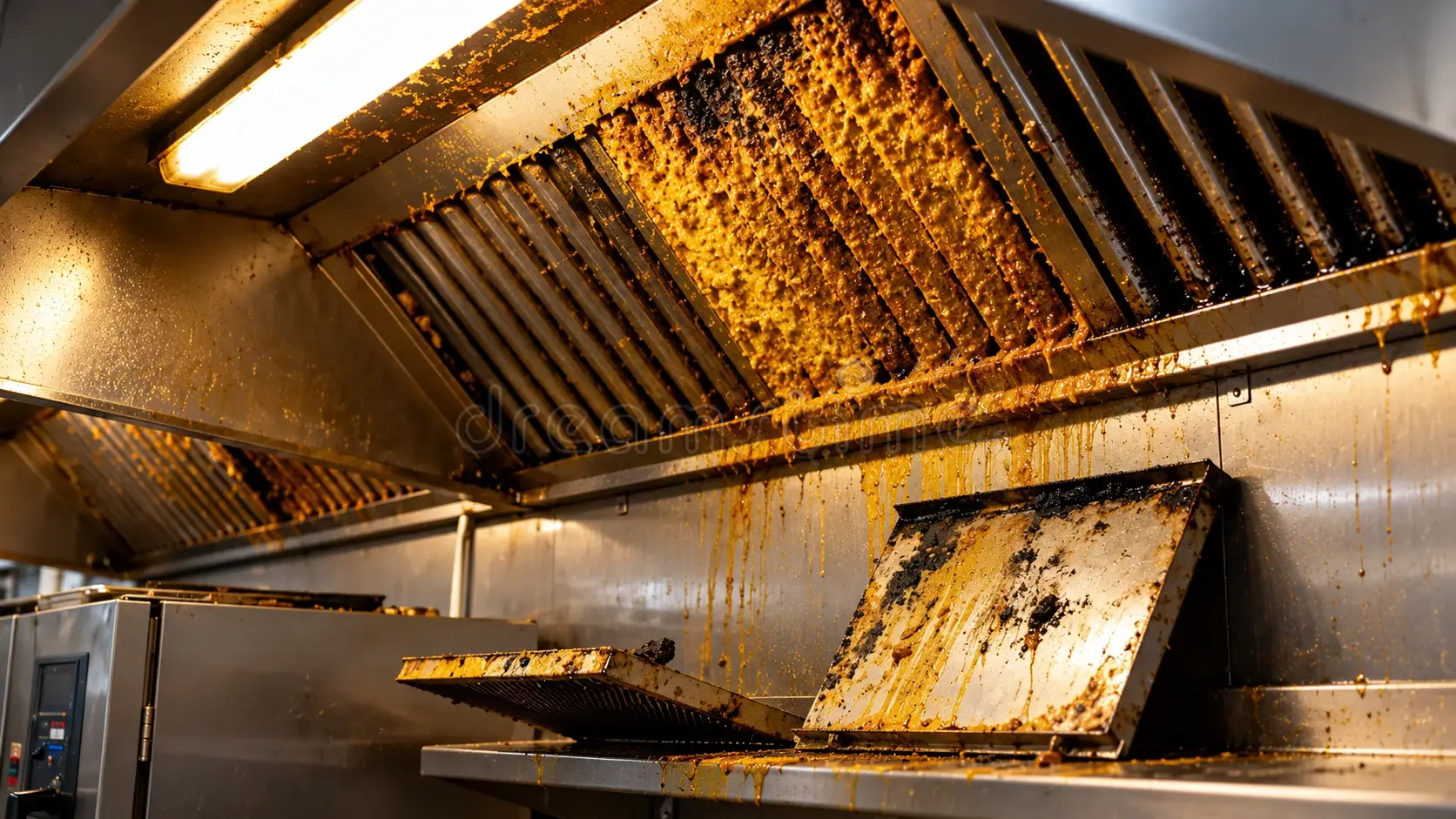
Cooking puts grease into the air. The hood pulls that grease up; the filters catch some of it; the rest condenses inside the ductwork as a coating of flammable residue. When that residue gets thick enough — and we’ll get to the specific limits in a moment — a single cooking flare-up can climb up through the ducts and turn into a building fire.
NFPA 96 exists to prevent that outcome. It sets an inspection schedule, a cleaning trigger, a list of who can do the work, and a documentation chain that proves the work happened. Insurance companies don’t write NFPA 96 into their policies, but they reference it as the baseline of reasonable care. If you’re maintaining the system the way the standard expects, you’re a manageable risk. If you’re not, your file says so before anyone has to ask.
The part most operators miss is where NFPA 96 puts responsibility. The standard names the equipment owner as the responsible party. The exact rule reads:
“The responsibility for inspection, testing, maintenance, and cleanliness of the ventilation control, fire protection, and cooking appliances of the commercial cooking operations shall be that of the equipment owner.”
NFPA 96, 2024 Edition, Section 4.1.5.1
The follow-on rule, Section 4.1.5.2, allows the equipment owner to assign that responsibility in writing — in a lease, a written use agreement, or a management contract — to the cooking operator, a management firm, or a managing individual. This matters because the carrier will look at the lease to see who is actually responsible for keeping the file. Where the lease is silent or unclear, both parties can find themselves exposed.
The Four Things an Insurance-Ready File Holds
Different carriers ask for slightly different sets of documents, but the underlying file is consistent across the industry. Four items. Each one ties back to a specific NFPA 96 rule.
| WHAT’S IN THE FILE | WHAT IT PROVES | NFPA 96 REFERENCE |
|---|---|---|
| Current sticker on the hood | Recent service, named technician, and a company the carrier can call. | Section 12.6.13, with details in 12.6.13.1 and 12.6.13.2 |
| Written inspection report | The technician looked at the system, identified where grease accumulation crosses the thresholds, and documented what could not be reached. | Section 12.6.14, with required contents in 12.6.14.1 |
| Written cleaning report | Cleaning was performed, the technician is named, and the report discloses which parts of the system were not cleaned. | Section 12.6.15, with required contents in 12.6.15.1 and 12.6.15.2 |
| Recurring service schedule | The kitchen is on a cadence that matches its cooking volume — monthly for solid fuel, quarterly for high-volume, semiannually for moderate, annually for low-volume operations. | Table 12.4 (the inspection schedule) |
A file with those four items, kept current, is what an insurance-ready hood cleaning file looks like. Anything missing is exactly what an outside reviewer will notice first.
The Service Label on the Hood — What It Tells a Loss-Control Rep in Fifteen Seconds
When an insurance loss-control representative walks into a commercial kitchen — at policy bind, at renewal, or after a claim — the first thing they look at on the equipment is the service label. NFPA 96, Section 12.6.13, requires that after every inspection or cleaning, an adhesive label be securely attached to the hood. The label must record three items by name:
- The date the work was performed, shown by a perforation — a punched dot on a calendar grid printed on the label.
- The name of the person who performed the work.
- The name, address, and phone number of the service provider.
The label must remain on the hood until the next service event under Section 12.6.13.2. Removing it, covering it, or letting it peel off breaks the chain.
Three questions get answered in fifteen seconds: when did the work happen, who performed it, and who is accountable for it. A hood with no label — or with an expired or incomplete label — turns a fifteen-second check into a longer conversation. The loss-control rep will ask for the written reports next.
A PRACTICAL POINT
Loss-control representatives do not arrive looking to fail an operator. They arrive looking for the documentation that proves reasonable care. A current service label, a recent written report, and a schedule that matches the kitchen’s cooking volume answers most of their questions before they ask.
The Two Reports — What They Have to Say
NFPA 96 requires two written reports, both delivered to the equipment owner within two weeks of the work. The inspection report follows the inspection. The cleaning report follows the cleaning. Both rules are covered in detail in our companion guide on what belongs in a real NFPA 96 cleaning report; the summary below highlights what the carrier reads first.
The inspection report rule reads:
“After an inspection for grease buildup is complete, a written report shall be provided to the system owner or owner’s agent (see 4.1.5) within 2 weeks.”
NFPA 96, 2024 Edition, Section 12.6.14
Section 12.6.14.1 lists six items the inspection report must record: any areas where grease accumulation crosses the thresholds in Section 12.6.1.1; any areas the technician could not reach and therefore did not inspect; any areas that could have been reached but were not; the locations of the duct access panels; any visible duct leakage; and any access panel that is itself leaking. Items two and three matter most to an underwriter — they force the inspector to disclose what was not done. A report with no inaccessible-area list is usually a report that did not look very hard.
The cleaning report rule reads almost identically:
“After cleaning is complete, a written report shall be provided to the system owner or owner’s agent (see 4.1.5) within 2 weeks.”
NFPA 96, 2024 Edition, Section 12.6.15
Section 12.6.15.1 covers the identification information — date, technician, service provider contact. Section 12.6.15.2 details what was not cleaned — areas the technician could not reach, areas that were reachable but skipped, the locations of the access panels, and any visible duct or panel leakage. The same honesty pattern as the inspection report.
An underwriter reading both reports sees a clean picture of the kitchen’s risk: the cooking-volume cadence, the inspection findings, the work that was performed, and the work that genuinely could not be performed. That picture is the file’s entire job.
FIELD NOTE
Across hundreds of kitchens served by Facilitec Southwest, loss-control representatives spend more time looking at the documentation file in the manager’s office than at the equipment in the kitchen. The hood gets a fifteen-second visual check for the service label. The file is where the underwriting decision is actually made. Operators who treat the documentation as an afterthought — and the cleaning visit as the real work — have the picture backwards. The cleaning visit produces the documentation; the documentation is what the carrier reads.
The Recurring Schedule — Matching Cadence to Cooking Volume
NFPA 96, Table 12.4, sets the inspection schedule by cooking volume and fuel type. There are four tiers, and most commercial operations fall into one of them. The full breakdown is in our guide to how often a commercial kitchen exhaust system should be cleaned; the table below summarizes.
| COOKING OPERATION | INSPECTION FREQUENCY | TYPICAL EXAMPLES |
|---|---|---|
| Solid-fuel cooking | Monthly | BBQ smokehouses, wood-fire pizza ovens, charcoal grills |
| High-volume cooking | Quarterly (every three months) | Twenty-four-hour kitchens, charbroiling operations, wok cooking |
| Moderate-volume cooking | Semiannually (every six months) | Most standard sit-down restaurants |
| Low-volume cooking | Annually | Churches, day camps, seasonal businesses, senior centers |
Table 12.4 is the inspection schedule — not a cleaning schedule. Cleaning is required under Section 12.6 only when an inspection finds grease deposits exceeding the thresholds in Section 12.6.1.1: 0.002 inches on hoods, grease removal devices, fans, and ducts (Section 12.6.1.1.1); 0.078 inches on other surfaces (Section 12.6.1.1.3); and 0.125 inches on fan housings (Section 12.6.1.1.4). In practice, most high-volume kitchens cross those limits at the inspection cadence anyway, so the inspection visit and the cleaning visit usually happen together. A Maintenance Program aligns the inspection cadence with the cooking volume up front, so the file stays current without operator follow-up.
An insurance underwriter looks at the service schedule and asks one question: does the cadence match how this kitchen actually cooks? A twenty-four-hour hospital cafeteria on an annual schedule is a red flag. A church social hall on a quarterly schedule is unnecessary. The cadence and the cooking volume need to line up.
What Happens at a Claim if the File Has Gaps
An overdue inspection or a missing report does not automatically void your coverage. It does change how a claim is handled.
After a commercial kitchen fire, the carrier’s investigation typically pulls the most recent inspection report, the most recent cleaning report, and the service label on the hood (or what remains of it). The investigator looks for two things: whether the system was being maintained at the cadence appropriate to the kitchen’s cooking volume, and whether the inspection cycle had been catching grease accumulation before it became dangerous. The companion post on what happens after a failed fire marshal inspection covers the parallel marshal-side process — and the two reviews often happen at the same time.
A complete file moves the investigation quickly. The carrier sees a current service label, a recent report dated within two weeks of the work, a named Certified Technician, and a schedule that matches the kitchen’s volume — and the file confirms reasonable care. A file with gaps — no recent service label, no report inside the two-week window, no record of the deficiencies that should have been visible — extends the investigation. Coverage outcomes are governed by the specific policy. The file is what the investigator reads first.
Building the File — A Five-Step Approach
Building an insurance-ready hood cleaning file is straightforward and easy to maintain. Five steps work for most operators across our service area in Texas, Oklahoma, Louisiana, New Mexico, and Arkansas.
- Identify the cooking-volume tier. Use the inspection schedule in NFPA 96, Table 12.4. Most full-service restaurants fall into the high-volume or moderate-volume tier. Hospitals, hotels with twenty-four-hour room service, and casino food courts are typically high-volume. Churches, day camps, seasonal restaurants, and senior centers are low-volume.
- Set the recurring schedule. The inspection schedule is the floor — the minimum the standard expects. Some operations run their cleaning cadence tighter to keep grease deposits below the thresholds at all times.
- Confirm the technician is certified. NFPA 96, Section 12.6.1, requires the work to be performed by a “properly trained, qualified, and certified” person accepted by the local fire marshal. The two credentials most fire marshals recognize are IKECA’s Certified Exhaust Cleaning Specialist (CECS) and Phil Ackland Training.
- Keep the documentation chain intact. The service label goes on the hood. The service tags go near any access panels that were opened (Section 12.6.10). The written reports — inspection and cleaning — go to the equipment owner within two weeks. Every piece stays in the file together.
- Share the file with the broker. Most brokers running restaurant insurance programs will accept the file at policy bind, at renewal, and at any loss-control visit. Some carriers offer credits or pricing tiers tied to documented fire-safety practices — ask the broker whether the carrier has one.
THE SAME FILE WORKS FOR THE FIRE MARSHALL
NFPA 96 requires records of compliance to be kept and made available to the local fire marshal (Section 12.1.4.2), and in some jurisdictions the inspection and cleaning reports must be submitted directly (Section 12.6.16). The same documents that satisfy the fire marshal also satisfy the insurance carrier. Build one file. Use it for both audiences.
How Facilitec Southwest Builds the File for Customers
Facilitec Southwest has served commercial cooking establishments across Texas, Oklahoma, Louisiana, New Mexico, and Arkansas since 1986. Every kitchen hood cleaning visit our Certified Technicians complete ends with three documentation steps. The adhesive service label goes on the hood per Section 12.6.13, with a perforation date, the technician’s name, and our company’s contact information. Where access panels were opened, the access-panel service tag goes near each one per Section 12.6.10. Within two weeks, the equipment owner receives a written report that addresses every item NFPA 96 calls for — including the items most operators do not realize are required, like the inaccessible-area list and the duct-leakage notes.
For multi-site portfolios — hotel groups, restaurant chains, hospital systems, casino properties — our NFPA Compliance Services consolidate the documentation across every location into a single file the broker or underwriter can read in one sitting. Facilitec Southwest follows NFPA 96 guidelines for cleaning and inspection of grease buildup. The documentation chain is part of that scope, not a separate add-on. The outcome is a grease-free, fire-safe facility and the peace of mind that comes with it.
Frequently Asked Questions
Does my insurance company require hood cleaning?
Most insurance companies writing commercial restaurant, hotel, hospital, or institutional kitchen policies require evidence that the kitchen exhaust system is being maintained against a recognized fire-safety standard. The standard they reference is almost always NFPA 96. The two documents they ask for most often are the current service label on the hood (Section 12.6.13) and a recent written report (Sections 12.6.14 and 12.6.15). Specific requirements vary by carrier and policy.
What hood cleaning documentation does a fire insurance carrier want to see?
Four items: a current service label on the hood showing the date, the technician name, and the company contact (Section 12.6.13); a written inspection report delivered within two weeks of the inspection (Section 12.6.14); a written cleaning report delivered within two weeks of the cleaning (Section 12.6.15); and a recurring service schedule that matches the cooking volume of the kitchen (the inspection schedule in Table 12.4).
Will documented hood cleaning lower my insurance premium?
It depends on the carrier and the program. Documented hood cleaning is usually a condition of coverage rather than a discount — meaning the documentation is required to keep the policy in force. Some carriers that specialize in restaurants offer loss-control credits or pricing tiers tied to documented fire-safety practices. Ask the broker.
What happens to my fire claim if hood cleaning is overdue?
An overdue inspection or cleaning does not automatically void coverage, but it can change how the claim is handled. After a fire, the carrier’s investigator pulls the most recent inspection and cleaning report, looks for the service label on the hood, and checks whether the schedule matched the kitchen’s cooking volume against the inspection schedule in Table 12.4. Gaps in the file extend the investigation. Coverage outcomes are decided by the specific policy. Facilitec Southwest is not an insurance advisor.
Who is responsible for keeping the hood cleaning records — landlord or tenant?
NFPA 96 makes the equipment owner responsible by default (Section 4.1.5.1). If the kitchen is leased, the lease can assign that responsibility to the cooking operator, a management firm, or a managing individual, as long as it is in writing (Section 4.1.5.2). In practice the lease decides — and the insurance carrier will usually look at both sides.
What is the difference between an inspection and a cleaning under NFPA 96?
An inspection is the measurement step — a properly trained, qualified, and certified person evaluates the system on the schedule set by Table 12.4 and measures grease accumulation against the thresholds in Section 12.6.1.1. A cleaning is required under Section 12.6 when the inspection finds grease deposits exceeding those thresholds. Table 12.4 is an inspection schedule, not a cleaning schedule — the two are deliberately separated in the standard, even though in high-volume kitchens the inspection and the cleaning often happen at the same cadence.
Sources: NFPA 96, 2024 Edition — Section 4.1.5 (owner-responsibility rule); Section 12.1.4.2 (records availability); Section 12.4 and Table 12.4 (the inspection schedule); Section 12.6 (cleaning of exhaust systems); Section 12.6.1 (the qualified-person rule); Section 12.6.1.1 (grease-depth thresholds); Section 12.6.10 (access-panel service tag); Section 12.6.13 (the hood-label rule); Section 12.6.14 (the two-week inspection report rule); Section 12.6.15 (the two-week cleaning report rule); Section 12.6.16 (the submission rule). Insurance practice descriptions reflect typical commercial restaurant program underwriting; specific carrier and policy requirements vary. Facilitec Southwest is not an insurance advisor; coverage outcomes are governed by the specific policy. We follow NFPA 96 guidelines for cleaning and inspection of grease buildup.