COMPLIANCE & REGULATIONS · FIRE PREVENTION
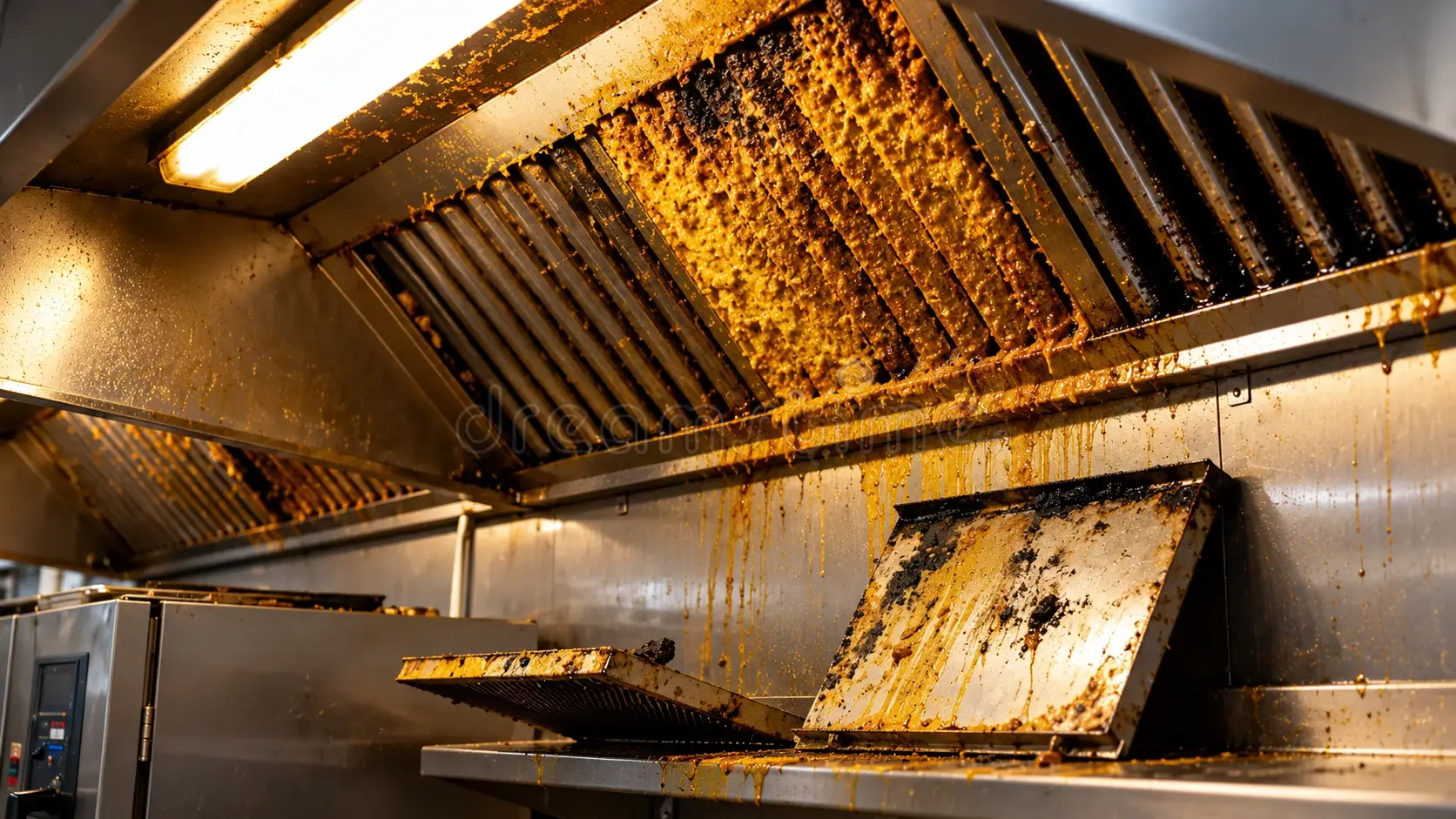
A commercial kitchen fire almost never begins the way most operators picture it. It starts small, hides in a place nobody can see, and travels through the exhaust system before anyone in the kitchen knows the flames have moved past the cookline. Here’s how the mechanics actually work, and what NFPA 96 requires to break the sequence.
August 11, 2026 · By Facilitec Southwest
QUICK ANSWER
Grease duct fires start when combustible grease deposits inside the exhaust system reach their auto-ignition temperature — typically around 600°F for most cooking oils and lower for aged, oxidized grease. Once ignited, the fire travels upward through the ductwork using the accumulated grease as fuel, potentially spreading to the exhaust fan, the rooftop, and the roof structure itself. NFPA 96 addresses this risk through required cleaning intervals (Table 12.4), the “bare metal” cleaning standard (Section 12.6.5), fire-rated duct enclosures, and fan hinge kit requirements (Section 8.1.1.1). Recurring Phil Ackland Certified cleaning that follows NFPA 96 removes the fuel load before ignition becomes possible.
PREVENT THE FIRE BEFORE IT STARTS
Facilitec Southwest delivers Phil Ackland Certified NFPA 96 cleaning across TX, OK, LA, NM, and AR — the recurring service that removes the fuel load before ignition is possible.
See Our Kitchen Hood Cleaning Service →
1. The Anatomy of a Commercial Kitchen Fire
Commercial cooking is the leading cause of structure fires in eating and drinking establishments across the United States, according to NFPA-published fire loss data. And within that category, grease is the primary fuel involved in the majority of fires that spread beyond the cooking equipment itself.
The pattern is consistent. A flare-up occurs at the cookline — usually at a fryer or a broiler. The fire suppression system may or may not activate. If it activates and confines the fire to the cooking equipment, the operator gets a manageable incident. If it doesn’t, or if the fire has already moved past the hood filters into the plenum before suppression discharges, the fire enters the exhaust system.
Once inside the ductwork, the fire has fuel it can travel on. Every inch of grease-laden interior surface is combustible. Every access panel that hasn’t been serviced holds concentrated deposits. Every foot of vertical duct becomes a chimney that draws air upward, feeding oxygen to the fire and accelerating its spread.
The commercial kitchen fires that make the news — the ones that burn to the roof, the ones that spread to adjacent tenant spaces, the ones that force multi-week closures and drive insurance claims — almost always follow this pattern. The fire didn’t stay at the cookline. It moved into the exhaust system, and the exhaust system had fuel waiting for it.
2. Where Grease Fires Actually Start
Ignition points vary, but the vast majority of commercial kitchen fires start in one of five places. Understanding the sequence helps operators think clearly about where prevention actually matters.
- The cookline surface. A flare-up at a fryer, char-broiler, or wok. Cooking oil overheats, ignites, and produces open flame at the pan or fryer basket. If suppression contains it here, the incident stays small.
- Inside the hood plenum. Aerosolized grease that passed through the baffle filters accumulates on the interior surfaces of the hood plenum. When flames from the cookline reach the filters, the plenum grease can ignite even if the fryer flare-up is contained.
- Inside the horizontal ductwork. Grease accumulates most heavily in the first ten to twenty feet of ductwork past the hood. Deposits in this section are typically the thickest and most oxidized in the whole system, and they represent the most immediate fuel source once fire enters the exhaust.
- Inside the vertical duct riser. As fire enters the vertical rise toward the roof, buildup on the interior duct walls extends the flame path. Depending on how tall the rise is and how much grease has accumulated, the fire can travel several stories before reaching the fan.
- At the exhaust fan and rooftop discharge. Fires that reach the fan often ignite grease deposits inside the fan housing and on the fan wheel. From there, the fire can spread to the fan curb, the roof membrane, and — if grease has migrated onto the roof — the surrounding rooftop surface.
The through-line: fire follows fuel. Grease is the fuel. Recurring NFPA 96 cleaning removes the fuel before it can carry a fire from the cookline to the rooftop.
3. How a Kitchen Fire Spreads Through the Exhaust System
Once ignition occurs inside the exhaust ductwork, three factors accelerate the spread.
The Chimney Effect
Commercial kitchen exhaust systems are designed to pull air upward from the cookline to the atmosphere. That design works normally as ventilation. During a fire, it works as a chimney. Rising hot air draws additional oxygen up through the system, feeding the fire and pulling flames further up the duct. The taller the vertical riser, the more pronounced the chimney effect.
The Aged Grease Load
Fresh grease on a clean surface is combustible but requires heat to ignite. Aged, oxidized grease — the deposits that have sat in a duct for months without cleaning — has different combustion characteristics. Oxidation lowers the effective ignition temperature. The longer the interval since the last cleaning, the more oxidized the accumulated grease, and the lower the temperature at which the fire can propagate.
The Structural Failure Point
Commercial exhaust ductwork is required to be constructed with fire-resistant materials and enclosed in fire-rated shafts under NFPA 96 Chapter 7. When the standard is followed, the enclosure buys time — the fire is contained inside the duct while the building’s fire suppression response mobilizes. When the standard is not followed, or when years of grease accumulation compromise duct integrity, the fire can breach the duct wall and spread into the building’s structure. This is the failure mode that turns a kitchen fire into a building fire.
FIELD NOTE — THE 500-SERIES STEEL TRUTH
Commercial grease ducts are required to be constructed from a minimum of 16-gauge carbon steel or 18-gauge stainless steel under NFPA 96 Section 7.5. That construction standard exists specifically to contain fires that ignite inside the duct — buying time for suppression and evacuation. But the standard also assumes the duct is being maintained, cleaned, and inspected on the NFPA 96 cadence. A duct that hasn’t been cleaned in three years has grease deposits that can burn hotter and longer than the material rating anticipates, potentially compromising the containment the material was designed to provide.
4. The Auto-Ignition Threshold: Why Temperature Matters
Auto-ignition is the temperature at which a combustible material will ignite spontaneously without an external flame or spark. For cooking oils and the grease residues they leave behind, this temperature is well below the operating range of a busy commercial kitchen.
| SUBSTANCE | APPROXIMATE AUTO-IGNITION RANGE |
|---|---|
| Vegetable and soybean cooking oils (fresh) | ~600°F to 700°F |
| Beef tallow and animal fats (fresh) | ~600°F to 720°F |
| Aged, oxidized grease deposits | Lower than fresh oil — varies by oxidation state |
| Char-broiler and open-flame cooking surfaces | Can produce localized temperatures well above 700°F |
The operational reality is that busy commercial kitchens can and do produce temperature spikes in the exhaust system that reach the auto-ignition range for accumulated grease. Char-broilers, high-BTU wok stations, and open-flame equipment all produce heat that can travel upward into the exhaust path. Without recurring cleaning, the exhaust system contains the fuel required for combustion. All that’s missing is the temperature spike that carries the ignition point across the auto-ignition threshold.
This is why NFPA 96 sets prescriptive inspection cadences in Table 12.4 rather than leaving cleaning to operator judgment. The standard is calibrated to remove combustible deposits before the accumulation reaches the density that supports sustained duct fire.
5. Why Fire Suppression Systems Are Not Enough
Every commercial kitchen with grease-producing appliances is required to have an automatic fire suppression system — typically a wet chemical system such as Ansul R-102 or equivalent. These systems are effective at what they’re designed to do. But operators who assume the suppression system alone protects them from fire risk miss what the suppression system doesn’t cover.
What the Suppression System Covers
- The cookline surface — the fryer, char-broiler, range, or wok itself
- The underside of the hood immediately above the cookline
- The plenum area just above the filters (on most systems)
- The initial section of duct entry (on most systems, through supplemental nozzles)
What the Suppression System Does Not Cover
- The full length of horizontal ductwork past the initial section
- The vertical duct riser
- The exhaust fan interior
- The rooftop discharge area and grease containment system
- Fires that ignite inside the duct from accumulated grease rather than from a cookline flare-up traveling upward
Suppression is the last line of defense. It responds when a fire has already started. What NFPA 96 cleaning does is remove the fuel that would let a fire spread past what suppression can contain. The two work together — one prevents the fuel load from building, the other responds when ignition still happens.
For a deeper look at the daily maintenance side that operators handle themselves, see our post on commercial kitchen grease filters as the first line of defense against a hood fire.
6. The NFPA 96 Sections That Address Fire Risk
NFPA 96 is a fire-safety standard, and every section in the document exists ultimately to prevent commercial kitchen fires or to contain them when they occur. Nine sections do most of the fire-prevention work.
| NFPA 96 SECTION | WHAT IT REQUIRES | FIRE RISK IT ADDRESSES |
|---|---|---|
| Chapter 7, Section 7.5 | Duct construction minimum 16-gauge carbon steel or 18-gauge stainless | Duct integrity during fire — containment of the flame inside the duct |
| Chapter 7, Section 7.8 | Fire-rated shaft enclosures around ductwork through occupied spaces | Preventing fire spread from duct to building structure |
| Chapter 8, Section 8.1 | Exhaust fan design and grease drainage requirements | Preventing fan-interior fire and rooftop grease ignition |
| Section 8.1.1.1 | Exhaust fan hinge kit requirement | Enabling interior fan inspection and cleaning to remove fuel load |
| Chapter 10 | Automatic fire suppression system requirements | Cookline fire response and initial containment |
| Chapter 12, Section 12.4 | Filter cleaning requirements (daily/weekly operator responsibility) | Reducing grease that passes through to plenum and ductwork |
| Section 12.6.1.1 | Inspection cadence per Table 12.4 | Detecting fuel-load buildup before ignition risk becomes critical |
| Section 12.6.4 | Accessibility of entire exhaust system for cleaning | Ensuring fuel load can be removed from every duct section |
| Section 12.6.5 | Cleaning to bare metal at accessible surfaces | Removing the fuel load itself before ignition is possible |
The standard is layered on purpose. Duct construction contains the fire if it starts. Suppression responds to cookline ignition. Recurring cleaning removes the fuel that would let a small fire spread. Documentation ensures accountability across the chain.
Our detailed explainer on what NFPA 96 Section 12.6.1.1 actually requires walks through the inspection and cleaning trigger in depth.
7. How Recurring Cleaning Actually Prevents Fires
The prevention mechanism is straightforward: remove the fuel and you remove the ability of the fire to spread. But the operational implementation requires understanding what recurring cleaning actually does and where it does it.
SIGNATURE APPROACH
From Cooktop to Rooftop, our Phil Ackland Certified Technicians clean to bare metal at every accessible surface NFPA 96 sets thresholds for. The outcome is a Grease-Free and Fire-Safe kitchen and the peace of mind that comes with it.
Cleaning to Bare Metal (Section 12.6.5)
A compliant cleaning removes grease, carbonized residue, and film from every accessible surface — hood interior, plenum, ductwork through opened access panels, exhaust fan, and rooftop discharge. The outcome is metal that can be visually inspected. Metal that can be visually inspected does not have combustible deposits sitting on it.
Access Panel Entry (Sections 12.6.4 & 12.6.10)
Ductwork is only accessible where access panels have been installed. NFPA 96 requires panels at intervals that allow the interior to be inspected and cleaned. Every panel opened during service must be tagged (Section 12.6.10) so fire marshals can verify the cleaning actually happened. Panels that were never opened during “cleaning” hide the deposits that create the highest fire risk.
Fan Interior Access (Section 8.1.1.1)
The exhaust fan is the last piece of equipment fire-laden vapor touches before atmosphere. Grease accumulation inside the fan housing and on the fan wheel creates a fire risk that suppression systems don’t cover and that fire marshals routinely cite when hinge kits are missing. Fans without hinge kits cannot be opened for interior inspection or cleaning. Facilitec Southwest’s exhaust fan repair service covers hinge kit retrofit alongside routine cleaning.
Recurring Cadence on Table 12.4
Cleaning removes the current fuel load, but grease begins accumulating again immediately after service ends. The Table 12.4 cadence — monthly, quarterly, semiannually, or annually depending on cooking operation — is calibrated so that the fuel load stays below the threshold that supports a duct fire. Skipping intervals or extending the cadence beyond Table 12.4 lets the load build to fire-supporting levels.
8. What to Do If a Grease Fire Starts
Prevention is the primary strategy. But every commercial kitchen operator should know the response sequence if a fire starts.
- Activate the fire suppression system. Most systems have a manual pull that discharges the wet chemical agent. This is faster than waiting for automatic activation and often the difference between a contained incident and a spreading fire.
- Shut down cooking equipment and gas supply. The suppression system typically triggers the gas shutoff automatically, but manual verification is critical. Removing the heat source stops the ignition process.
- Evacuate the kitchen and building. Follow the facility’s fire response plan. Direct guests and staff to marked exits.
- Call 911. Do not attempt to fight a duct fire beyond the cookline. Fires inside ductwork are not accessible to portable extinguishers and can propagate much faster than the responder can move.
- Do not restart cooking operations. The system must be inspected, cleaned, recharged, and cleared for return to service by both the fire suppression vendor and the local AHJ.
Portable Class K extinguishers (rated for cooking-oil fires) are appropriate for small cookline flare-ups that suppression may miss. They are not appropriate for fires that have moved past the filters into the exhaust system. If the fire is out of your reach, it’s out of your control — evacuate and let responders handle it.
9. After a Fire — The Compliance and Insurance Response
The response after a fire runs on two parallel tracks: getting the kitchen back into operation, and satisfying the fire marshal and insurance carrier that the system is safe to run again.
Fire Marshal Response
The local AHJ will investigate the fire and determine cause. If the cause is traceable to grease accumulation, the operator may face citations, fines, and mandatory documentation of NFPA 96 compliance going forward. See our post on failed fire marshal inspections for the step-by-step deficiency response.
Insurance Response
The insurance carrier will investigate the claim and request the operator’s cleaning documentation. Missing or incomplete NFPA 96 records — no service label, no access panel tags, no written reports — can lead to reduced claim payouts, coverage disputes, or in some cases denial of coverage entirely. Our post on what your insurance carrier actually wants to see covers the documentation chain in detail.
Fire Suppression System Recharge
The suppression system must be inspected, cleaned, and recharged by a licensed suppression vendor before cooking operations resume. This is separate from NFPA 96 hood cleaning and requires its own service call.
Full Exhaust System Cleaning
The entire exhaust system must be professionally cleaned and inspected before return to service. Fire residue, structural damage, and post-fire deposits all require attention from Phil Ackland Certified Technicians. See our Kitchen Hood Cleaning service for post-fire response.
FIELD NOTE — THE DOCUMENTATION THAT CHANGES THE INSURANCE CONVERSATION
Operators who can produce three years of dated Phil Ackland Certified cleaning records — service labels on the hood, access panel tags in place, and written reports on file — enter the insurance conversation from a defensible position. The claim is being evaluated on the merits of the incident, not on whether the operator maintained the system. Operators without documented service history often find themselves defending against an accusation of negligence rather than filing a claim. Recurring service on the NFPA 96 cadence produces the paperwork that makes the difference.
Frequently Asked Questions
What causes grease duct fires in commercial kitchens?
Grease duct fires start when accumulated grease deposits inside the exhaust system reach their auto-ignition temperature — typically around 600°F for fresh cooking oils and lower for aged, oxidized grease. High-heat cooking equipment (char-broilers, wok stations, open-flame equipment) can produce temperature spikes in the exhaust path that carry the ignition point across the threshold when the fuel load is present.
At what temperature does cooking grease catch fire?
Fresh vegetable and animal cooking oils generally auto-ignite in the 600°F to 720°F range. Aged, oxidized grease deposits — the material that accumulates in an unserviced exhaust system — can ignite at lower temperatures because oxidation changes the combustion characteristics. Exact ignition temperature varies by oil type, oxidation state, and duct conditions.
How does a fire spread through a kitchen exhaust system?
Three factors accelerate spread: the chimney effect (exhaust design pulls hot air and fire upward), the aged grease load along duct interior walls (fuel that supports continued combustion), and structural failure points if the ductwork has been compromised by inadequate maintenance. The fire travels from the cookline through the plenum, into horizontal ductwork, up the vertical riser, and can reach the exhaust fan and rooftop.
Isn’t the fire suppression system enough to prevent kitchen fires?
Suppression systems (Ansul R-102 and equivalents) cover the cookline surface, the underside of the hood, the plenum above the filters, and typically the initial section of duct entry. They do not cover the full ductwork run, the vertical riser, the exhaust fan interior, or the rooftop. Suppression responds to ignition; NFPA 96 cleaning removes the fuel that would let a small fire spread past what suppression can contain.
How often should kitchen exhaust cleaning happen to prevent fires?
NFPA 96 Table 12.4 sets the minimum inspection cadence: monthly for solid-fuel cooking and 24-hour operations, quarterly for high-volume kitchens, semiannually for moderate-volume, and annually for low-volume. The cadence is calibrated to keep the fuel load below the threshold that supports sustained duct fire. See our full explainer on how often you should clean your commercial kitchen exhaust system.
What NFPA 96 sections address fire prevention?
Nine sections do most of the fire-prevention work: Chapter 7 (duct construction and fire-rated enclosures), Chapter 8 (fan design and hinge kit requirements), Chapter 10 (automatic fire suppression), Section 12.4 (filter maintenance), Section 12.6.1.1 (inspection cadence), Section 12.6.4 (accessibility), and Section 12.6.5 (cleaning to bare metal).
Where do most commercial kitchen fires start?
Ignition typically starts at the cookline (fryer, char-broiler, wok) as a flare-up. If suppression contains it there, the incident stays small. If the fire moves past the filters into the plenum, or if it ignites accumulated grease inside the ductwork, it can spread through the exhaust system and become significantly larger.
What should I do if a fire starts in the kitchen?
Activate the fire suppression system, shut down cooking equipment and gas supply, evacuate the building, and call 911. Do not attempt to fight a fire that has moved past the cookline into the ductwork — those fires are not accessible to portable extinguishers and can spread faster than a responder can move. Class K portable extinguishers are appropriate only for small cookline flare-ups.
Does insurance require documented hood cleaning after a fire?
Insurance carriers routinely request NFPA 96 documentation when evaluating fire claims. Missing service labels, absent access panel tags, or incomplete written reports can lead to reduced payouts, coverage disputes, or denial of coverage. Documented Phil Ackland Certified service history is the operator’s protection in the post-fire insurance conversation.
Can a grease duct fire spread to the building structure?
Yes, if NFPA 96 duct construction (Chapter 7) and fire-rated shaft enclosures (Section 7.8) are compromised. Properly constructed and maintained ductwork is designed to contain the fire inside the duct while suppression responds. Ductwork with structural damage, unsealed access panels, or years of unremoved grease accumulation can fail to contain the fire and allow spread into the building structure.
How does Facilitec Southwest prevent grease duct fires?
Our Phil Ackland Certified Technicians clean to bare metal at every accessible surface NFPA 96 sets thresholds for — hood, plenum, ductwork through opened access panels, exhaust fan, and rooftop discharge. Recurring service on the Table 12.4 cadence removes the fuel load before ignition is possible. Every visit includes the full documentation chain: service label, access panel tags, and written report inside two weeks. Learn more about our Kitchen Hood Cleaning service.
SOURCES AND NOTES
NFPA 96, 2024 Edition — Chapter 7 (duct construction, Section 7.5 minimum steel thickness requirements, Section 7.8 fire-rated shaft enclosures); Chapter 8 (Sections 8.1–8.3 exhaust termination and fan design; Section 8.1.1.1 exhaust fan hinge kit requirement); Chapter 10 (automatic fire suppression system requirements); Chapter 12, Section 12.4 (filter cleaning); Section 12.6.1 (qualified-person rule); Section 12.6.1.1 (inspection requirement); Table 12.4 (inspection frequency by cooking operation); Section 12.6.4 (accessibility); Section 12.6.5 (cleaning to bare metal); Section 12.6.13 (service label); Section 12.6.15 (written cleaning report). Auto-ignition temperature ranges reflect industry-published values for common commercial cooking oils and animal fats; exact ignition temperature varies by oil type, oxidation state, and duct conditions. Fire loss statistics reference National Fire Protection Association published data on structure fires in eating and drinking establishments; specific incident data varies year over year. Fire suppression coverage references standard wet-chemical system design (Ansul R-102 and equivalent Class K suppression systems); actual suppression coverage varies by system design and installer specifications. IKECA references are to the International Kitchen Exhaust Cleaning Association’s CECS (Certified Exhaust Cleaning Specialist) and CECI (Certified Exhaust Cleaning Inspector) credentials, and ANSI/IKECA C10 industry standard. Phil Ackland Training is an internationally recognized training program for kitchen exhaust system inspection and cleaning. Facilitec Southwest holds Phil Ackland Certification for its technicians and follows NFPA 96 guidelines for cleaning and inspection of grease buildup. This article is a fire-prevention reference, not legal, engineering, or AHJ-specific advice. In the event of an active fire, activate suppression, evacuate, and call 911.