PRE-INSPECTION CHECKLIST
An inspection date on the calendar usually means one of three things: a routine visit, a reinspection, or a permit renewal. The list of what gets checked is shorter and more predictable than most operators realize. Here is the pre-walk-through, in the same order the inspector will use it.
June 05, 2026 · By Facilitec Southwest
A fire marshal or a health inspector walks into the kitchen with a clipboard and a depth gauge. They are not there to find new things to fail the operator on. They are there to confirm a small set of items meets the code — and most of those items are visible from where they are standing. When the kitchen walks itself, in the same order the inspector will, surprises are rare.
This is the pre-inspection checklist for a commercial kitchen exhaust system. It covers what a fire marshal looks at, what a health inspector looks at (a different lens, overlapping items), the seven specific things to check forty-eight hours before the visit, and how to handle anything that fails the self-check before the inspector arrives. The full text of the cited sections is available on our NFPA 96 Codes reference page.
QUICK DEFINITIONS, BEFORE WE GO FURTHER
Fire marshal is the city or state official who enforces fire and life-safety codes. Health inspector is the city or county official who enforces food-safety and sanitation codes. They are different people from different agencies; their kitchen visits sometimes overlap. NFPA 96 is the National Fire Protection Association’s rulebook for commercial cooking hoods, ducts, and exhaust fans — the standard fire marshals cite. The current edition is the 2024 edition. Exhaust system is the entire grease path: hood, filters, ductwork, fan.
What a Fire Marshal Looks At
A fire marshal’s kitchen visit follows a predictable pattern. They look at seven things, usually in the order below. Most marshals will explain what they are checking as they go — they are not trying to be mysterious. They are verifying documentation and observable condition against the local fire code, which is almost always built on NFPA 96 for commercial cooking. For restaurants, hotels, hospitals, schools, casinos, and other commercial cooking operations, this is the consistent pattern.
1. The service sticker on the hood
The first thing they look at. NFPA 96 requires an adhesive label securely attached to the hood after every inspection or cleaning under Section 12.6.13. The label must show the date of service (with a perforation marking it), the technician’s name, and the service provider’s name, address, and phone number. The label must remain on the hood until the next service event under Section 12.6.13.2. The companion guide on what belongs in a real NFPA 96 cleaning report and what the service label should say covers the full documentation chain.
What gets a kitchen cited: no label at all, an expired date, a missing technician name, missing company contact information, or a label that has been removed.
2. The most recent written report
Next they ask for the written inspection report — or the cleaning report if cleaning was performed. NFPA 96 requires both to reach the kitchen owner within two weeks of the work (the two-week report rules, Sections 12.6.14 and 12.6.15). They will check the date, the contractor’s name, and whether the report addresses what was found, what wasn’t reached, and what wasn’t done.
What gets you cited: no report on file; a report older than the inspection cadence allows for your cooking volume; a report missing the required content (areas not inspected, access panel locations, duct leakage).
3. Grease depth on the system surfaces
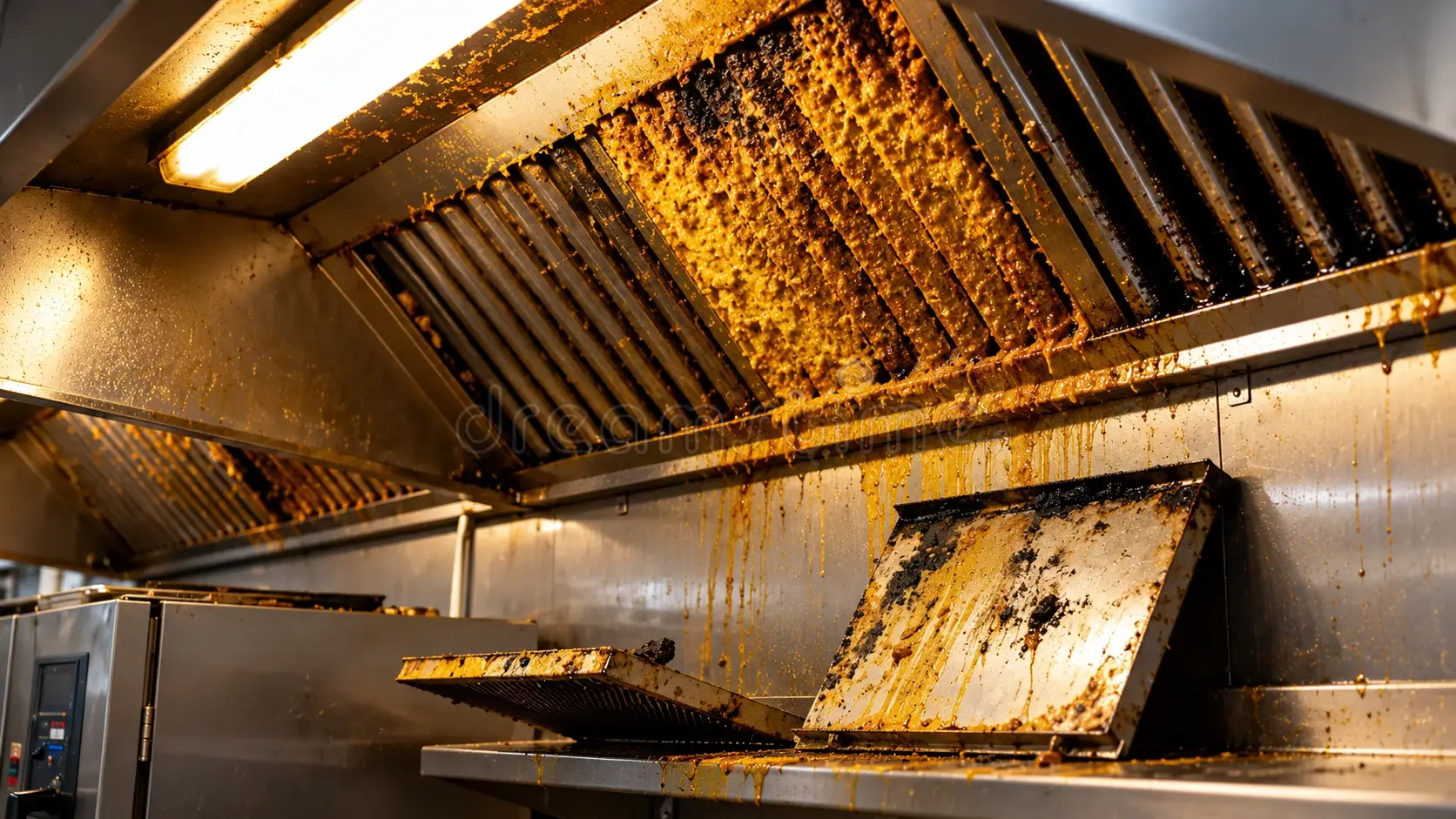
The marshal pulls out a depth gauge — a small comb-shaped tool — and measures the grease on the hood interior, the filters, accessible duct surfaces, and the fan. NFPA 96 sets three grease-depth limits under Section 12.6.1.1: 0.002 inches (50 micrometers — about a sheet of copy paper) on hoods, filters, fans, and ducts (Section 12.6.1.1.1); 0.078 inches (about two millimeters) on other surfaces (Section 12.6.1.1.3); 0.125 inches (one-eighth of an inch) on fan housings (Section 12.6.1.1.4). Any limit crossed requires cleaning. The companion guide on how often a commercial kitchen exhaust system should be cleaned walks through the inspection cadence in Table 12.4 and the relationship to these thresholds.
What gets you cited: any measured grease depth over the applicable limit.
4. Duct access panels
Access panels are the small doors built into the ductwork so a technician can reach inside to clean it. The marshal will look at whether the panels are present, reachable (not blocked by stored items or covered by remodel work), and properly tagged after the last cleaning. NFPA 96 requires a small service tag near each access panel that was opened (Section 12.6.10).
What gets you cited: missing panels, panels covered by drywall or sealed in a remodel, panels blocked by storage, or panels with no service tag near them.
5. The fire suppression system
The wet-chemical fire suppression system in the hood — the one designed to spray a fire-quenching agent on the cooking line if a flare-up happens — has to be serviced by a qualified contractor at least every six months. That’s the suppression-maintenance rule (Section 12.2.1). The marshal looks at the service tag on the system and at the fusible links (the small metal-alloy parts that trigger the system at a set temperature; these have to be replaced at least once a year).
What gets you cited: an expired or missing suppression service tag, fusible links overdue for replacement, or a system that has been triggered and not reset.
6. Grease drip containers
The metal containers used to catch grease — under fryers, at the discharge of the roof exhaust fan, anywhere grease can pool — must be inspected or emptied at least weekly under Section 12.6.17. The marshal will check the containers visible from inside the kitchen and may go to the roof to check the one at the fan discharge. Where grease management has been a chronic issue, our Grease Containment service handles the rooftop containers and the under-fryer collection on a recurring cadence.
What gets you cited: overflowing containers, missing containers, containers obstructing access to other equipment, or grease pooling on the roof from a missing or overflowed container.
7. Employee training records
NFPA 96 requires that new employees be trained on hire — and that all employees be trained annually — on how to use portable fire extinguishers and how to manually activate the hood’s fire suppression system (the employee-training rule, Section 12.1.4). Records of that training have to be maintained and available to the marshal (Section 12.1.4.2).
What gets you cited: no training records on file, training records that don’t cover all current employees, or records older than a year for the annual refresher.
What a Health Inspector Looks At
A health inspector’s lens is sanitation, not fire safety — but the equipment overlaps. The grease and ventilation issues that concern a fire marshal also concern a health inspector when they create food-safety risks. Five items recur on the health-inspection side.
Filter Condition and Grease Dripping
Health inspectors check whether the baffle filters in the hood are clean and properly installed. A filter that drips grease back onto the cookline is a food-safety violation. Filters caked with grease that have not been removed for cleaning are a fire-safety issue and a sanitation issue at the same time. The companion guide on commercial kitchen grease filters as a first line of defense walks through how daily and weekly filter cleaning closes this category of citation.
Grease Pooling on or Near the Hood
When grease is visibly pooling on the hood exterior, on the wall above the cookline, or on the floor under the hood, the health inspector will flag it. Active grease on surfaces near food preparation creates a contamination pathway. It also flags inadequate ventilation upstream.
Pests and Harborage
Heavy grease accumulation creates the kind of harborage where roaches, rodents, and other pests live. Health inspectors who see grease at the levels NFPA 96 prohibits will often follow the trail and find pest evidence elsewhere in the kitchen. The hood condition is sometimes the first signal of a deeper sanitation problem.
Hood and Ductwork Condition
Inspectors will look at the hood interior surface — whether it has been cleaned, whether it has rusted-through holes, whether it has been altered in ways that affect food-contact surfaces. A damaged hood or a duct with visible leakage is a sanitation citation as well as a fire-code one.
Documentation That the Local Code Requires for Permit Retention
Some city and county health departments require proof of recent hood cleaning as part of permit retention or food-service license renewal. Where that applies, the health inspector may ask for the most recent NFPA 96 written report alongside the fire-side documentation. Whether this applies depends on the local code.
The Forty-Eight-Hour Self-Check — Run This Two Days Before the Inspection
Walk the kitchen yourself, in the same order an inspector will. Two days out is usually the right window: enough time to correct anything you find, not so far out that conditions change before the visit.
Pre-Inspection Self-Check (48 Hours Out)
- Look at the service label on the hood. Is the date current? Is the technician named? Is the company’s contact information present? Is the label still securely attached?
- Pull the most recent written inspection or cleaning report. Is it inside the two-week window from the last service? Does it cover every item NFPA 96 requires?
- Visually check the hood interior, the filters, and the visible duct surfaces. Is there grease visibly thicker than a sheet of paper? When yes, schedule corrective cleaning.
- Find every duct access panel. Is each one reachable? Is there a service tag near it from the last cleaning?
- Read the fire suppression service tag. Is the most recent service dated within the last six months? Are the fusible links within the semiannual replacement window?
- Empty and clean every grease drip container — under fryers and at the rooftop exhaust fan.
- Verify the employee fire-safety training records. Are all current employees covered? Is the annual refresher within the last twelve months?
When any item fails the self-check, schedule corrective service before the inspection. A kitchen hood cleaning company can usually mobilize inside forty-eight hours — and for an urgent reinspection scenario, our After Hours Service can correct most issues overnight. The companion guide on what happens after a failed fire marshal inspection covers the deficiency-response side of that work.
FIELD NOTE
Across pre-inspection walkthroughs Facilitec Southwest has performed across the Southwest, the most overlooked item on the seven-point list is the employee fire-safety training record. Operators almost always remember the hood documentation because the cleaning company delivers it. The training record is created internally — which is exactly why it falls through the cracks. Building a once-a-year training session into the kitchen calendar, with a signed and dated roster, closes the most commonly missed citation pattern. It costs nothing and takes one staff meeting.
A PRACTICAL POINT
The strongest pre-inspection is the one a kitchen does not have to do. A kitchen on a properly scheduled NFPA 96 maintenance cadence — with the inspection cycle, the cleaning trigger, the suppression service, and the documentation all on a single calendar — passes most inspections without a self-check. The pre-walk is the safety net, not the primary plan.
What to Have in the Documentation Folder
The inspector may ask to see paperwork. Have it ready in one folder, in one place, in this order:
| DOCUMENT | WHAT IT PROVES | HOW RECENT IT HAS TO BE |
|---|---|---|
| Most recent written hood inspection report | System was inspected by a qualified person within the inspection cadence required by Table 12.4 for the kitchen’s cooking volume | Within the inspection cadence (monthly, quarterly, semiannually, or annually) |
| Most recent written hood cleaning report (if applicable) | Cleaning was performed when triggered by Section 12.6.1.1 thresholds, with required content per Section 12.6.15 | Within the inspection cadence, dated within two weeks of the cleaning |
| Fire suppression service report | The wet-chemical system was serviced by a qualified contractor | Within the last six months (Section 12.2.1) |
| Fusible link replacement record | The metal-alloy detection links are within their replacement window | Within the last year (Section 12.2.4) |
| Employee fire-safety training records | New employees trained on hire, all employees retrained annually on extinguisher and suppression-system use | Annual refresher within the last 12 months (Section 12.1.4.2) |
| Cooking equipment service record (if separate) | The cooking equipment itself was inspected and serviced | Within the last year (Section 12.7.1) |
Keep the folder physically at the kitchen if the local code requires it on-site, or have it digitally accessible in under a minute. The inspector wants to see the file, not hear that “the corporate office has it.”
The Five Things That Most Often Get a Kitchen Cited
Across kitchens Facilitec Southwest serves in Texas, Oklahoma, Louisiana, New Mexico, and Arkansas, five citation patterns recur on fire-marshal inspections.
- Grease accumulation past the depth limits (NFPA 96, Section 12.6.1.1 — the grease-depth rule).
- Missing or expired service sticker on the hood (Section 12.6.13 — the hood-label rule).
- No written report on file inside the two-week window (Sections 12.6.14 and 12.6.15 — the two-week report rules).
- Blocked, missing, or untagged duct access panels (Section 12.6.10 — the access-panel tag rule).
- Fire suppression system overdue for its six-month service (Section 12.2.1 — the suppression-maintenance rule).
The pattern these five share is documentation. Each one is a paperwork problem before it becomes a hardware problem. A current service label, a recent report, and a maintenance cadence on the calendar usually closes the most common citations before they happen. The companion guide on what an insurance carrier wants to see in a hood cleaning file covers the parallel review the insurance underwriter runs on the same documentation set.
How Facilitec Southwest Builds the Pre-Inspection File
For our customers across Texas, Oklahoma, Louisiana, New Mexico, and Arkansas, the pre-inspection file is built at the service visit, not the day before the marshal arrives. Every cleaning ends with the service sticker affixed to the hood (hood-label rule, Section 12.6.13), service tags at any access panels that were opened (Section 12.6.10), and the written report to the kitchen owner inside the two-week window (the two-week report rules). Where local jurisdictions require submission to the AHJ, we handle that too (Section 12.6.16).
Customers on our Maintenance Program get the inspection-and-cleaning cadence set to the cooking volume, the documentation cycle handled, and the file built continuously rather than scrambled for at the last minute. For multi-site portfolios, our NFPA Compliance Services consolidate the file across every location into one place a fire marshal or insurance underwriter can read in a single sitting. Our Certified Technicians have served commercial cooking establishments since 1986 — four decades of fieldwork against the same standard, in front of every fire marshal in the region. Facilitec Southwest follows NFPA 96 guidelines for cleaning and inspection of grease buildup. From cooktop to rooftop, clean to bare metal. The outcome is a grease-free, fire-safe facility and the peace of mind that comes with it.
Frequently Asked Questions
What do fire inspectors look for in a commercial kitchen?
Seven items in order: the service sticker on the hood (current date, technician name, company contact); the most recent written inspection or cleaning report on file; grease depth measured against the NFPA 96 limits; duct access panels (present, reachable, properly tagged); the fire suppression system service tag (within the last six months); grease drip containers under fryers and at the roof exhaust fan; and employee fire-safety training records.
What do health inspectors look for in a commercial kitchen exhaust system?
The sanitation lens on the same equipment: clean filters with no grease dripping into food prep areas, no grease pooling on or near the hood, the absence of pests created by grease accumulation, proper hood and ductwork condition, and any service documentation the local health code requires for permit retention.
How do I prepare for a fire marshal kitchen inspection?
Walk the kitchen 48 hours out using the seven-item checklist above. Confirm the sticker, pull the most recent report into a folder, visually check for grease over the depth limits, find every access panel, read the suppression service tag, empty the grease drip containers, and verify the employee training records. Fix anything that fails before the inspector arrives.
What documentation should I have ready before a fire marshal inspection?
The most recent hood inspection report, the most recent cleaning report (if cleaning was triggered), the fire suppression service report from the last six months, the fusible link replacement record, the employee fire-safety training records, and the cooking equipment annual service record. Keep them in one folder, in order, accessible in under a minute.
What gets a commercial kitchen cited most often during inspection?
Five patterns: grease past the depth limits (Section 12.6.1.1), missing or expired hood sticker (Section 12.6.13), no written report inside the two-week window (Sections 12.6.14 and 12.6.15), blocked or missing access panels (Section 12.6.10), and overdue fire suppression service (Section 12.2.1).
Are fire marshal and health inspections the same visit?
No. The fire marshal works for the city or state fire department and enforces fire and life-safety codes anchored in NFPA 96. The health inspector works for the city or county health department and enforces food-safety and sanitation codes. They sometimes overlap on equipment — clean filters, no grease pooling, proper ventilation — but they are separate visits, separate inspectors, and separate citation chains. A kitchen prepared for one is usually prepared for the other, because the documentation and the equipment condition are the same evidence in both reviews.
Sources: NFPA 96, 2024 Edition — Section 12.1.4 (employee training); Section 12.1.4.2 (training records availability); Section 12.2.1 (suppression-maintenance rule); Section 12.2.4 (fusible link replacement); Section 12.4 and Table 12.4 (inspection schedule); Section 12.6 (cleaning of exhaust systems); Section 12.6.1.1 (grease-depth thresholds); Section 12.6.10 (access-panel tag rule); Section 12.6.13 (hood-label rule); Section 12.6.14 (two-week inspection report rule); Section 12.6.15 (two-week cleaning report rule); Section 12.6.16 (AHJ submission); Section 12.6.17 (grease drip container weekly inspection); Section 12.7.1 (cooking equipment annual inspection). Health-inspection observations reflect typical sanitation review practice; local codes vary. We follow NFPA 96 guidelines for cleaning and inspection of grease buildup.