COMPLIANCE & KITCHEN MAINTENANCE
The filters above the cookline do more grease-removal work than any other part of the exhaust system — and they are the one part NFPA 96 expects the kitchen to maintain, not the kitchen exhaust cleaning service. Here is what they do, who is responsible for cleaning them, how often, and what the standard requires.
June 05, 2026 · By Facilitec Southwest
Walk into any commercial cooking establishment and the first piece of fire-safety equipment in plain view is the row of metal panels sitting at an angle inside the hood. Those are the grease filters. They sit between the cookline and the ductwork, and they are quietly doing the most consequential job in the exhaust system. Every droplet of grease the cooking sends into the air must pass through them before it can travel anywhere else.
The filters are also the part of the system most kitchens do not maintain on the right schedule. The hood is professionally cleaned once a quarter, twice a year, or once a year, depending on the kitchen’s cooking volume. The filters need attention every week, and in a high-volume kitchen, every day. The gap between how often the filters need care and how often the kitchen actually provides it is one of the most common contributors to hood fires we see in the field.
This guide is written for kitchen managers, restaurant owners, executive chefs, head porters, and multi-unit operators responsible for keeping commercial cooking operations running safely. It walks through what grease filters do, why they matter so much for fire safety, who is responsible for cleaning them, how often, and what NFPA 96 — the national fire-safety standard for commercial cooking — actually requires. The full text of the cited sections is available on our NFPA 96 Codes reference page.
QUICK DEFINITIONS, BEFORE WE GO FURTHER
Grease filter: the removable panel inside a commercial kitchen hood that captures grease from the rising cooking vapor and drains it down into a tray. Baffle filter: the standard modern grease filter — a series of vertical metal vanes that fling grease onto the metal as the air zig-zags through. Mesh filter: an older, simpler woven-wire filter no longer allowed as the primary filter under NFPA 96. Grease drip tray: the small trough under the filter bank that catches the grease the filters shed. NFPA 96: the national fire-safety standard for commercial cooking ventilation; the current edition is the 2024 edition.
What a Grease Filter Actually Does
Picture a cookline at full service. A flat-top griddle is cooking burgers. A char-broiler is searing steaks. A fryer is dropping a basket of frozen onion rings into 350-degree oil. Every one of those processes is sending grease into the air — not just smoke and steam, but tiny airborne droplets of fat that have evaporated off the food. Those droplets rise.
The hood above the cookline catches them. The exhaust fan on the roof pulls them upward through the ductwork. And in between the hood and the duct, sitting at an angle the standard requires, is the grease filter.
Inside a baffle filter, the air is forced to zig-zag through a series of vertical metal vanes. The air can change direction quickly because air is light. The grease droplets, which are heavier than air, cannot. They slam into the metal surface, condense, and run down the vane into the drip tray. The clean air keeps moving up into the duct. The grease stays behind in the tray.
That is the entire purpose of the filter. It is a separator. It pulls grease out of the air before the air gets anywhere else in the system. Everything else in the exhaust pathway — the inside of the duct, the welds, the fan housing, the access panels, the rooftop curb — only sees the grease the filter failed to catch.
The Number One Defense
Michael Hinderliter, who founded Facilitec Southwest in 1986 and has been working in commercial kitchen exhaust safety for four decades, puts it this way:
“The filters are very important important to be cleaned. Daily if possible, no less than once a week. Because it’s the first line of defense at keeping grease from building up inside the kitchen exhaust system.”
— Michael Hinderliter, Facilitec Southwest
That framing is worth sitting with for a moment. A commercial hood fire happens when grease that has built up inside the system gets hot enough to ignite. That grease did not get inside the duct on its own. It got there because the filters let it through. The filters either were not there, or were clogged shut so the air found a path around them, or were installed in the wrong orientation, or were missing the drip tray underneath, or were simply too saturated with old grease to capture any more.
When the filters do their job, the rest of the exhaust system stays comparatively clean between professional visits. The fire suppression system has less to defend against. The fire-marshal inspection goes more smoothly. When the filters do not do their job, every part of the system downstream of them starts loading up with grease faster than the cleaning schedule can handle. Grease fires destroy buildings, end businesses, and put lives at risk — and the filter bank is the place where most of that risk is decided.
FIELD NOTE
In hundreds of kitchens across the Southwest, the single most reliable predictor of how a hood will look at the next professional cleaning is the condition of the filters between visits. Locations whose porters wash the filters at end of service consistently arrive at the next quarterly visit with a hood interior that needs less aggressive work. Locations whose filters are visibly clogged on arrival almost always have heavy grease at the duct entry — even if the cleaning interval is the same.
Whose Responsibility Is Filter Cleaning?
This is the part most kitchen operators get wrong, and it is the single most important point in this guide.
The kitchen cleans the filters. Not the hood cleaning company. The kitchen.
The professional Certified Kitchen Exhaust Cleaning service — the one that arrives once a quarter, twice a year, or annually and takes the hood, the duct, and the fan back down to bare metal — is responsible for the full system cleaning under NFPA 96. That visit happens on a cadence aligned with the inspection schedule in Table 12.4, calibrated to cooking volume and fuel type. The companion guide on how often a commercial kitchen exhaust system should be cleaned walks through the four-tier inspection schedule in full.
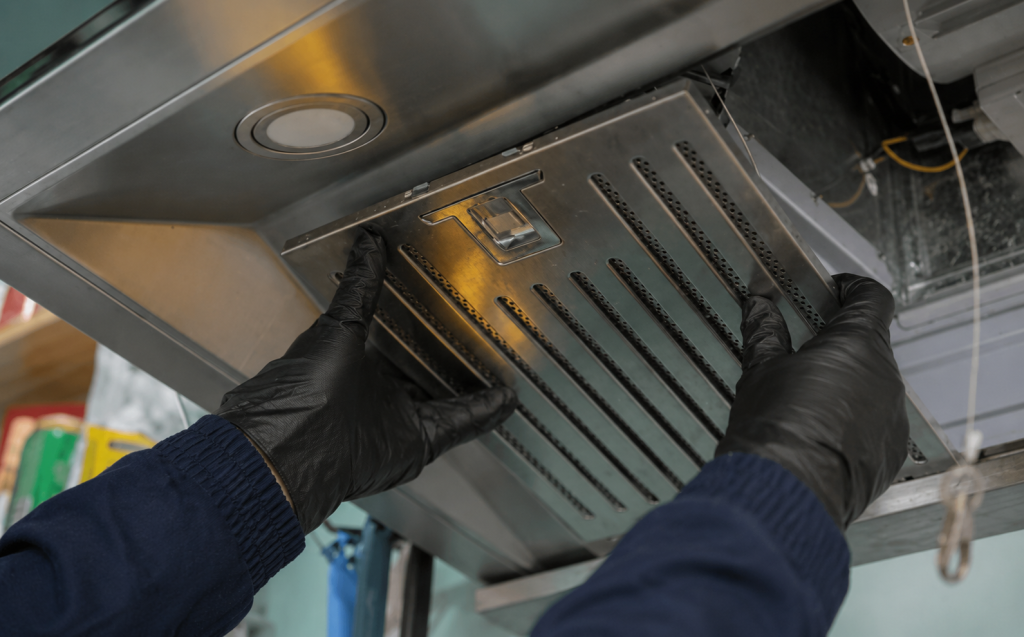
The frequent care of the filters — the daily and weekly washing that keeps them open and effective between professional visits — belongs to the location. The cooking staff. The porter. The closing crew. Whoever the kitchen has designated to handle daily sanitation. That is the person who pulls the filters out of the hood, washes them, and slides them back into place.
NFPA 96, Section 4.1.5, places the broader responsibility for cleanliness of the ventilation and cooking equipment on the equipment owner — meaning the operator of the cooking establishment, not the service provider. Filter care is a daily expression of that responsibility.
Some kitchen exhaust cleaning companies, including Facilitec Southwest, can add filter cleaning to the professional visit as an optional service. We pressure-wash the filters in our truck while we are on site cleaning the hood. Some customers ask for that. It is an addition, not a substitute. Filters need attention every week or every day. A professional cleaning visit happens once every three months to once a year. The math does not allow the kitchen exhaust cleaning provider to be the only party touching the filters.
THE BOTTOM LINE ON RESPONSIBILITY
The location handles routine filter cleaning. The Certified Kitchen Exhaust Cleaning service handles the full NFPA 96 hood, duct, and fan cleaning at the cadence aligned with Table 12.4. Filter cleaning can be added to the professional visit as an optional service, but it does not replace the daily or weekly care that filters require between visits.
How Often Should the Kitchen Clean the Filters?
The frequency depends on what the kitchen is cooking, and how much of it. Here is the rule of thumb, calibrated to the same cooking-volume tiers NFPA 96 uses for the professional inspection schedule.
| Cooking Style | Filter Cleaning Cadence | Typical Examples |
|---|---|---|
| High-volume cooking and solid fuel | Daily, at end of service | Twenty-four-hour kitchens, charbroil operations, wok cooking, wood-fire pizza, BBQ smokehouses, heavy frying |
| Moderate-volume cooking | Every two to three days, minimum weekly | Most full-service sit-down restaurants, hotel kitchens, hospital food service |
| Low-volume cooking | Weekly | Churches, day camps, senior centers, seasonal businesses, school cafeterias on a light schedule |
The cadence is calibrated to how quickly the filter loads up. A charbroil station running ribeyes for eight hours can saturate a baffle filter inside a single shift. A senior center serving soft scrambled eggs three mornings a week may not saturate a filter for a month. Most commercial kitchens land somewhere in the middle and need at least a weekly cadence.
One simple test: if the filter comes off the hood and the grease has filled the channels of the baffles, the kitchen is already late. The filter should have been cleaned before that point.
What NFPA 96 Requires for Grease Filters
NFPA 96 is the national fire-safety standard for commercial cooking ventilation. The current edition, the 2024 edition, sets the rules every commercial kitchen in the United States is expected to follow. Several rules in Chapter 6 of the standard apply directly to grease filters, and a few in Chapter 12 address their use and replacement.
The Filter Must Be Listed (Section 6.2.3.1)
A grease filter cannot be a generic piece of perforated metal. It must be tested and approved by a recognized testing agency — a process called listing. The listing means the filter has been evaluated against UL 1046, the safety standard for grease filters, and confirmed to capture grease, drain it properly, and resist fire propagation. The listing label is on the edge of the filter frame.
The Filter Must Be Noncombustible and Rigid (Sections 6.2.3.2 and 6.2.3.3)
Grease filters have to be made from noncombustible material — usually stainless steel or galvanized steel — and they have to be built rigidly enough that they will not warp or buckle from the heat of the cooking below. A bent filter is a fire hazard. The vanes inside the filter no longer line up the way the engineers designed them to, and grease starts traveling through the gaps instead of getting captured.
All the exhaust air has to pass through the filters (Section 6.2.3.4)
The filter bank has to be arranged so that every cubic foot of exhaust air leaving the hood passes through a filter. There cannot be a gap above the filters or a missing filter slot that lets air sneak past. This is one of the things a fire marshal or a certified inspector will check for during an inspection. If a filter is missing from the bank, the kitchen is in violation of NFPA 96 the moment the hood is turned on.
The filter has to be easy to remove (Section 6.2.3.5)
The standard requires that filters be easily accessible for removal. This is for a practical reason: filters that are hard to get out do not get cleaned. NFPA 96 expects that the design of the hood will support frequent filter removal, and it expects the kitchen staff to actually use that access.
The filter has to be installed at 45 degrees from horizontal (Section 6.2.3.6)
Grease filters cannot be installed flat. They have to be tilted at an angle of at least 45 degrees from horizontal. The angle matters because gravity is what moves the captured grease out of the filter and into the drip tray below. A flat filter holds the grease inside the baffle channels until it overflows. An angled filter sheds the grease continuously as it captures it.
The drip tray has to be there (Section 6.2.4.1)
NFPA 96 requires a grease drip tray underneath the filters to catch the grease the filters shed. The drip tray drains into a small grease cup, which has to be checked regularly. If the cup overflows, the grease starts pooling on top of the cookline equipment, which is exactly the wrong direction.
The system cannot be run without the filters (Section 12.1.2)
This is the rule kitchen managers most often violate, sometimes without realizing it. NFPA 96, Section 12.1.2, says it plainly: “Filter-equipped exhaust systems shall not be operated with filters removed.” If the filters have been pulled for cleaning, the cooking equipment underneath them needs to be off until the filters go back in. Running a hood with empty filter slots sends raw, unfiltered grease straight into the ductwork. It also voids the listing of the hood, which can become a problem during an insurance claim after a fire.
Broken filters have to be replaced (Section 12.6.18)
NFPA 96, Section 12.6.18, requires that grease removal devices that are broken, distorted, or missing components be replaced. A bent baffle is not something to keep using until the next cleaning. The filter has to come out and a new one has to go in.
Filter orientation has to be visible (Section 6.2.5)
Grease filters that require a specific orientation — most baffle filters do — have to be marked on the face of the filter so the orientation is visible after the filter is installed, or the hood or filter has to be built so it physically cannot be installed in the wrong direction. This rule exists because a filter installed upside down does not drain. The grease pools inside the baffle channels and runs downward into the cooking equipment instead of into the drip tray.
A NOTE ON MESH FILTERS
Grease filter: the removable panel inside a commercial kitchen hood that captures grease from the rising cooking vapor and drains it down into a tray. Baffle filter: the standard modern grease filter, a series of vertical metal vanes that fling grease onto the metal surface as the air zig-zags through. Mesh filter: an older, simpler woven-wire filter that is no longer allowed as the primary filter under NFPA 96. Grease drip tray: the small trough under the filters that catches the grease they shed. NFPA 96: the national fire-safety standard for commercial cooking ventilation; the current edition is the 2024 edition.
How to Clean a Grease Filter the Right Way
The operator-side procedure below is what kitchen staff should be doing at the end of a shift or service, on the cadence above.
DAILY OR WEEKLY FILTER CLEANING PROCEDURE
- Turn off the cookline equipment underneath the hood. Burners off, gas off, fryer covered. Let the equipment cool enough that the filters are safe to handle.
- Leave the exhaust fan running for a few more minutes to clear residual smoke and steam from the hood before the filters come out.
- Pull each filter straight up and out of its slot. Most baffle filters have a small handle or finger pull. Wear cut-resistant gloves — the edges are sharp.
- Empty the drip tray underneath the filter bank into a designated grease container. If the cup is approaching full, it is past time to empty.
- Soak the filters in hot water and a commercial degreaser. A three-compartment-sink soak works, as does a dedicated filter soak tank in the back of house. Most baffle filters can also go through a high-temperature dish machine, but the filter manufacturer’s instructions should be checked first.
- Scrub any remaining grease out of the baffle channels with a stiff nylon brush. Do not use steel wool — it can scratch the stainless and create points where grease will start sticking.
- Rinse the filters thoroughly with clean hot water until no degreaser residue remains.
- Allow the filters to dry completely before reinstalling. Wet filters will spit water down onto the cookline the moment the fan kicks back on.
- Reinstall in the correct orientation. Check the orientation marking on the filter face. If you are not sure which way is up, the manufacturer’s logo is almost always meant to be readable from the cookline side after installation.
- Wipe down the drip tray and the grease cup while the filters are out — this is the easiest moment to access them.
The whole procedure takes about fifteen to twenty minutes for a standard six-filter hood. In a high-volume kitchen doing this every night, the closing porter can finish it before the dishwasher is done with the last rack.
The Hood-Cleaning Visit and Filter Cleaning Together
When a Certified Kitchen Exhaust Cleaning service comes in to do the full NFPA 96 hood cleaning, the filters come out as part of the access work. Our Certified Technicians have to remove the filters to get to the hood plenum, the duct entry, and the upper inside surfaces that need to be cleaned to bare metal.
At that moment, the filters are out, and they can be cleaned at the same time. Hood cleaning with Facilitec Southwest can include pressure-washing the filters in our truck or at an on-site cleaning station, added to the visit as an optional service. Some customers ask for that and add it to their standing Maintenance Program. Some customers prefer to have their own staff clean the filters during the visit while we are working on the hood.
Either is fine. What is not fine is leaving the filters uncleaned between hood cleaning visits. A baffle filter that has not been touched in three months does not work as a filter anymore. It works as a barrier — air finds the path of least resistance around it, and grease goes wherever the air goes.
What Happens When Filter Cleaning Is Neglected
Walk through what a neglected filter actually does to the exhaust system over time.
Week one with a saturated filter: the baffle channels are coated with grease, but the filter still works. Air slows down. The fan has to work harder. Some of the grease the filter could not capture starts to coat the inside surface of the duct just above the filter bank.
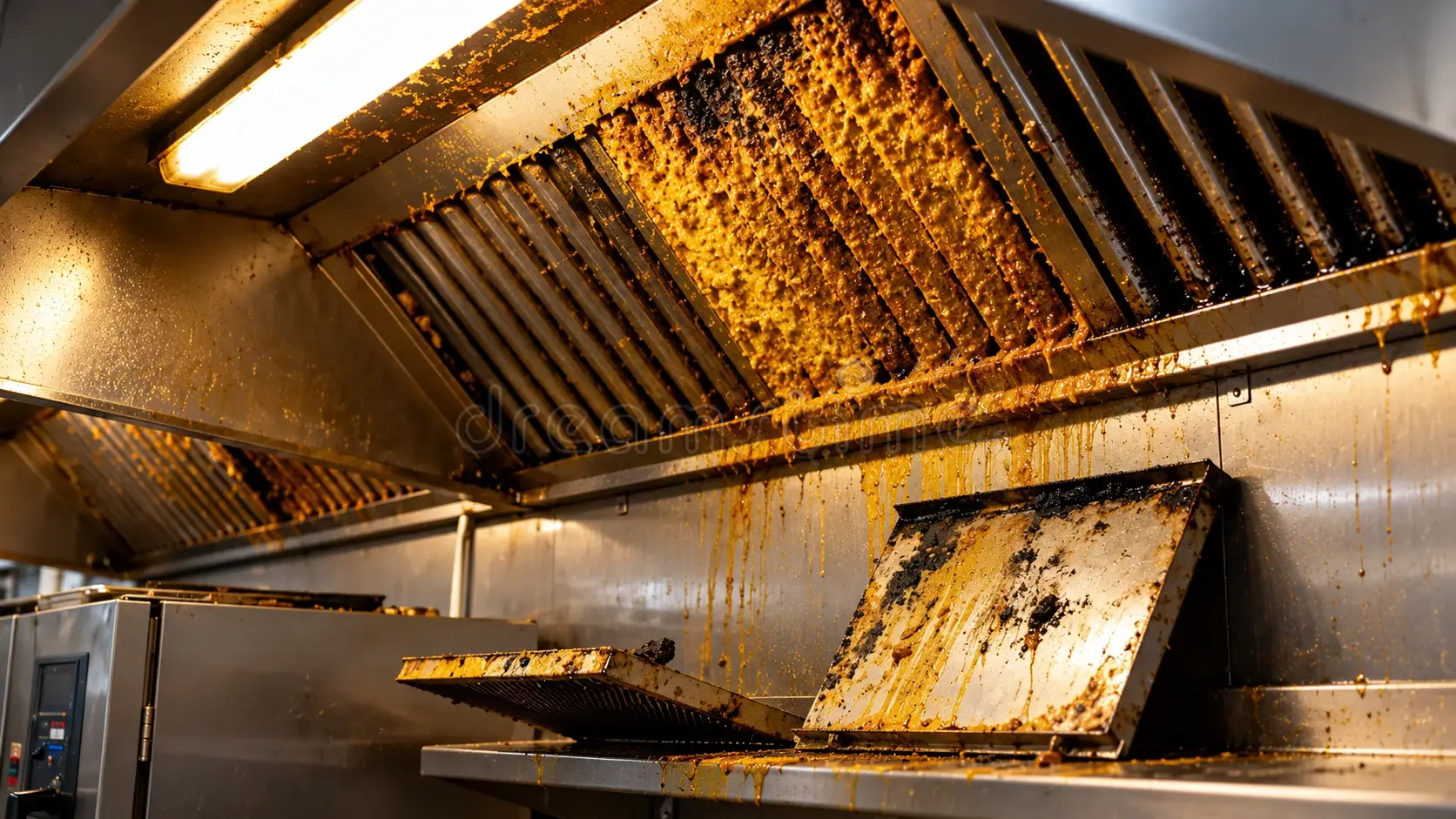
Month one with a saturated filter: the baffle channels are fully blocked. Air now travels around the edges of the filter where it sits in its slot, bypassing the filter entirely. Raw, unfiltered grease is going into the duct. The inside of the duct is loading up at the rate the cooking produces grease — much faster than the cleaning schedule was designed to handle.
Month three with a saturated filter: the duct is heavily coated with grease. The grease at the bottom of the duct, near the filter bank, has been baking from the heat below and has hardened into a layer that requires aggressive cleaning to remove. The fan housing is also coated. If a flame from the cookline reaches the duct entry — a flare-up from a fryer, a grease fire on a charbroil — the grease in the duct can ignite. That is a hood fire.
This is the trajectory every commercial kitchen that neglects its filters is on. The timeline can be faster or slower depending on volume, but the direction is the same. The single intervention that stops the trajectory is the kitchen staff pulling the filters and washing them on the right cadence.
Filter Cleaning, the Insurance File, and the Fire Marshal
Insurance underwriters and fire marshals do not usually ask for filter-cleaning records the way they ask for hood-cleaning records, but they pay attention to the visible condition of the filters during an inspection. A bank of clean, properly installed, properly oriented baffle filters tells the inspector that the kitchen is being run by someone who understands the system. A bank of clogged, missing, or upside-down filters tells the inspector the opposite — and once that impression forms, the rest of the inspection gets a lot less forgiving.
For multi-unit operators, adding a filter-cleaning log to the kitchen sanitation routine — a simple sign-off sheet near the dish station — is one of the easiest documentation upgrades available. It costs nothing, takes about thirty seconds a day, and creates a record an insurance underwriter or fire marshal can review on request. The companion guide on what an insurance carrier wants to see in a hood cleaning file covers the full documentation chain underwriters look for.
How Facilitec Southwest Works With Customers on Filter Care
Facilitec Southwest has served commercial cooking establishments across Texas, Oklahoma, Louisiana, New Mexico, and Arkansas since 1986. When we set up a new customer, the filter conversation is part of the first walkthrough. We look at the filter bank to confirm the filters are listed, properly oriented, and the right type. We check the drip tray. We replace any filters that are bent, missing, or out of spec under Section 12.6.18.
We then talk through the daily and weekly cleaning routine with the kitchen manager or restaurant owner, so the staff understands the cadence and the procedure. On the professional kitchen hood cleaning visits — quarterly, semiannually, or annually depending on the kitchen’s cooking volume — the filters come out as part of the work. We can pressure-wash the filters during that visit as an optional add-on, or the kitchen can do the filters while we are on site.
Every visit closes the way every NFPA 96 cleaning visit should close: the service label affixed to the hood per Section 12.6.13, the service tag at each access panel that was opened per Section 12.6.10, and the written report delivered to the equipment owner within the two-week window per Section 12.6.15. Our companion guide on what belongs in a real NFPA 96 cleaning report and what the service label should say walks through that documentation in detail. We follow NFPA 96 guidelines for cleaning and inspection of grease buildup. From cooktop to rooftop, clean to bare metal. That is the work.
Frequently Asked Questions
How often should commercial kitchen grease filters be cleaned?
At least weekly in most kitchens, and daily at the end of service in high-volume kitchens (twenty-four-hour operations, charbroiling, wok cooking, heavy frying, and solid-fuel cooking). NFPA 96 does not set a numeric frequency for routine filter cleaning, but Section 12.1.2 requires the exhaust system never operate with filters removed, and Section 12.6.18 requires replacement of any filter that is broken, distorted, or missing components.
Whose responsibility is grease filter cleaning?
The kitchen operator’s. Routine filter cleaning belongs to the cooking staff or porter on a daily or weekly cadence. The Certified Kitchen Exhaust Cleaning service handles the full NFPA 96 hood, duct, and fan cleaning at the cadence aligned with the inspection schedule in Table 12.4 — and can include filter cleaning during that visit as an optional service. Section 4.1.5 places overall responsibility for cleanliness of the equipment on the equipment owner.
Why do kitchen grease filters matter so much?
They are the first thing pulling grease out of the cooking vapor before it travels anywhere else in the exhaust system. When the filters are clean and properly installed, the rest of the system stays cleaner between professional visits. When the filters are clogged or missing, raw grease coats the duct and the fan housing at the rate the kitchen produces it — which is faster than the cleaning schedule was designed to handle, and is how hood fires start.
What does NFPA 96 say about grease filters?
Filters must be listed (Section 6.2.3.1), noncombustible (Section 6.2.3.2), rigid (Section 6.2.3.3), arranged so all exhaust air passes through them (Section 6.2.3.4), easy to remove (Section 6.2.3.5), installed at a minimum forty-five-degree angle (Section 6.2.3.6), and equipped with a grease drip tray underneath (Section 6.2.4.1). Orientation must be visible after installation (Section 6.2.5). The exhaust system cannot operate with filters removed (Section 12.1.2). Broken, distorted, or missing-component filters must be replaced (Section 12.6.18).
Can mesh filters be used in a commercial kitchen hood?
No — not as the primary filter. NFPA 96, Section 6.1.3, prohibits mesh as the primary filter unless it was evaluated as an integral part of a listed grease filter assembly. The standard primary filter in a modern commercial hood is the listed baffle filter, made of stainless or galvanized steel, with vertical vanes that fling grease onto the metal and drain it down into the trough below.
Does Facilitec Southwest clean grease filters?
Yes — filter cleaning can be added as an optional service on a kitchen hood cleaning visit. When our Certified Technicians clean a hood under NFPA 96, the filters come out as part of the access work, and we pressure-wash them in the truck or on site. We recommend the kitchen staff handle daily and weekly filter cleaning between professional visits, because that is the cadence the filters actually need.
What is a baffle filter and how is it different from a mesh filter?
A baffle filter is a series of vertical metal vanes that force the air to zig-zag through, slamming the heavier grease droplets onto the metal surface where they drain down into a trough. A mesh filter is a woven wire screen that traps grease by surface contact. Baffle filters are required under NFPA 96 as the primary filter in modern commercial hoods. Mesh filters are not allowed as a primary filter unless they are part of a listed assembly.
What happens if a grease filter is installed upside down?
The grease no longer drains into the drip tray — it pools inside the baffle channels and eventually runs down onto the cooking equipment below. The filter also stops functioning as designed, which sends more grease into the duct. NFPA 96, Section 6.2.5, requires that grease filters either be marked with their correct orientation on the visible face, or be built so they physically cannot be installed in the wrong orientation.
Sources and notes: NFPA 96, 2024 Edition — Section 4.1.5 (equipment owner responsibility); Section 6.1.3 (mesh filter prohibition as primary); Section 6.2.3.1 (filters must be listed); Section 6.2.3.2 (noncombustible material); Section 6.2.3.3 (rigid construction); Section 6.2.3.4 (all exhaust air through filters); Section 6.2.3.5 (easy removal); Section 6.2.3.6 (forty-five-degree minimum angle); Section 6.2.4.1 (grease drip tray required); Section 6.2.5 (orientation visible after installation); Section 12.1.2 (no operation without filters); Section 12.6.10 (access-panel service tag); Section 12.6.13 (service label affixed to hood); Section 12.6.15 (two-week written cleaning report); Section 12.6.17 (grease drip container weekly inspection); Section 12.6.18 (broken or distorted filters must be replaced). Operator-side cadence guidance reflects Facilitec Southwest field experience with commercial cooking establishments across the Southwest since 1986. Facilitec Southwest follows NFPA 96 guidelines for cleaning and inspection of grease buildup.