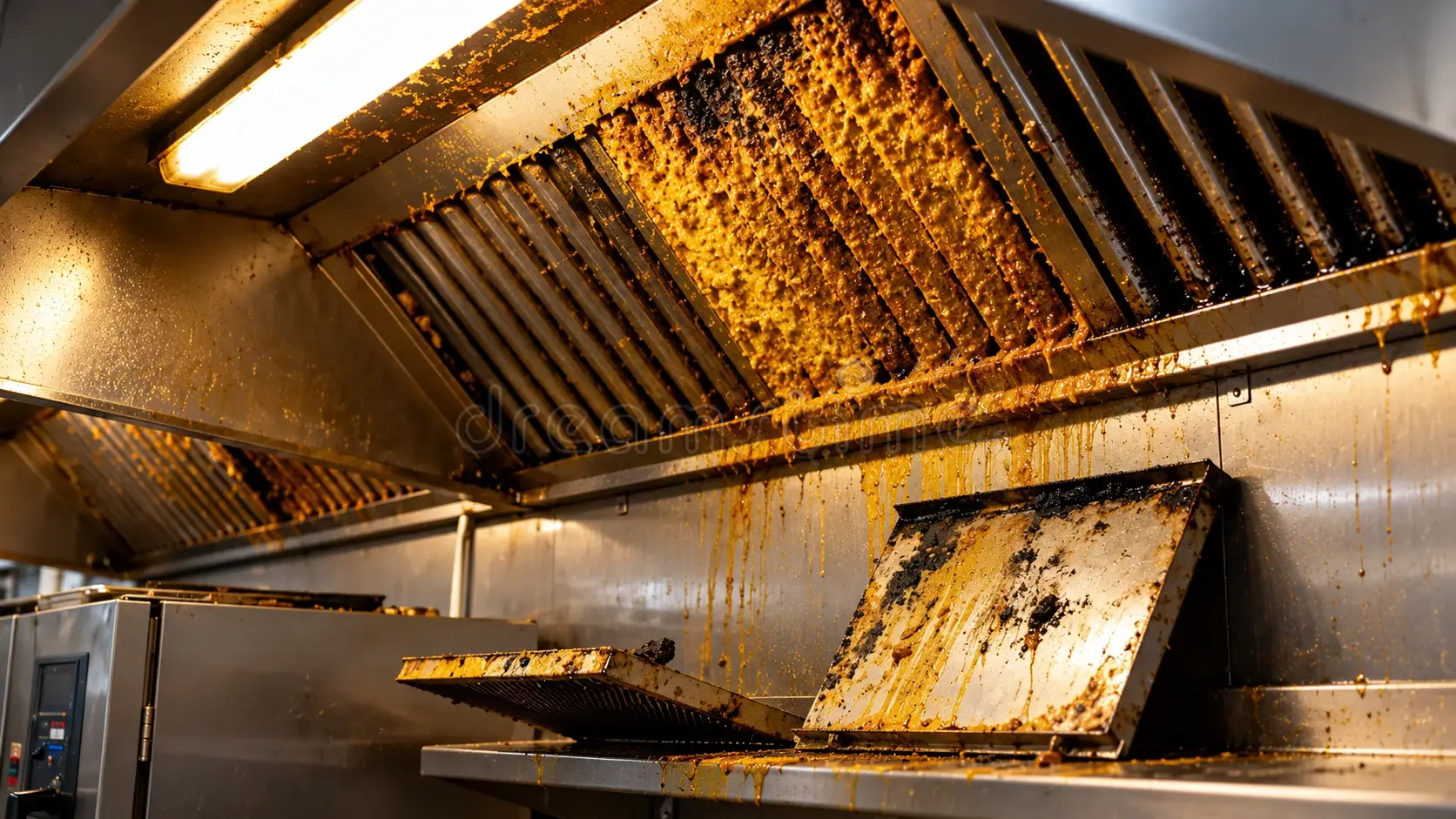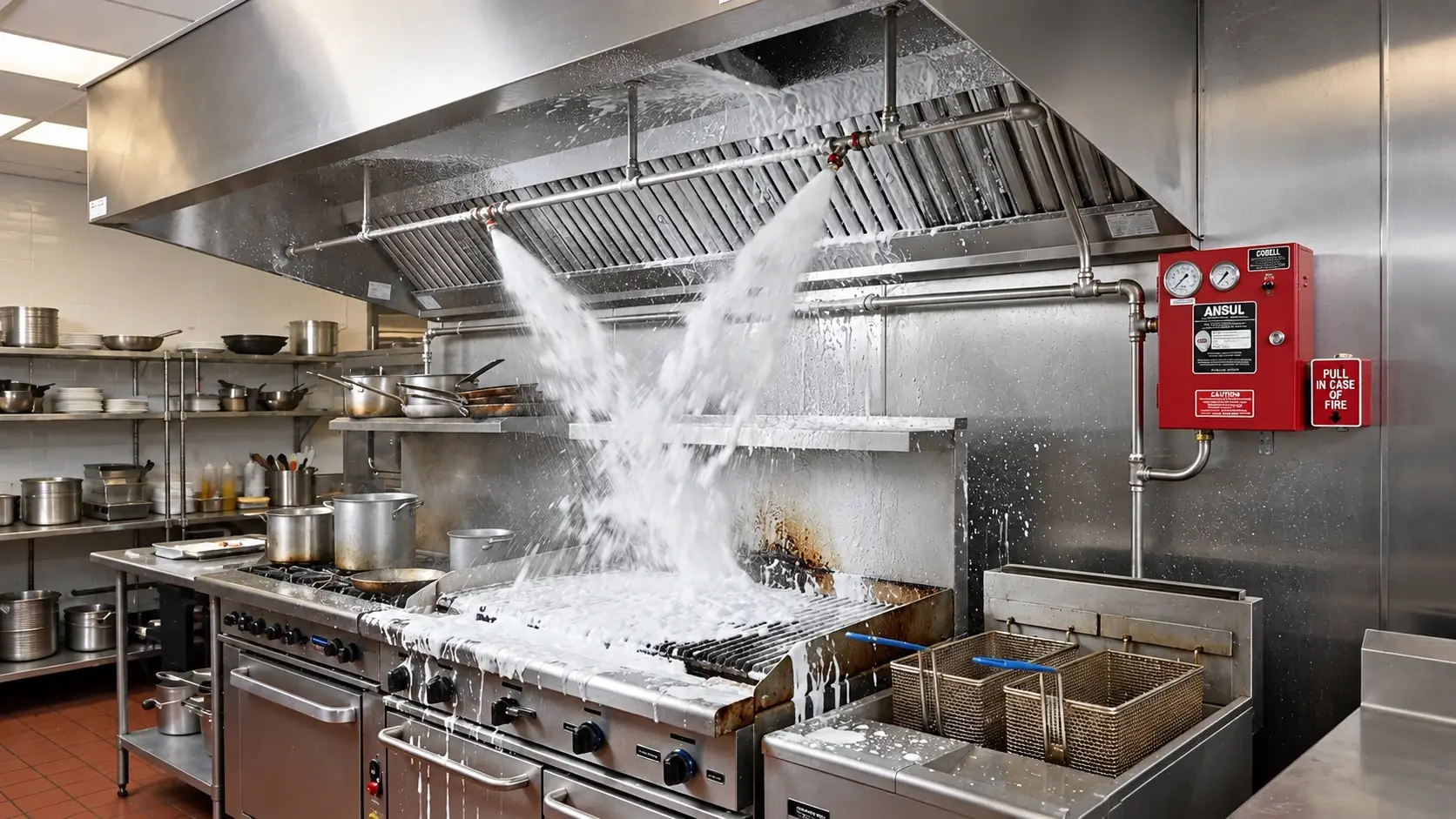
OPERATIONS & REGULATIONS · FIRE PROTECTION
A restaurant operator calls to schedule hood cleaning and asks, “Will you check the Ansul system while you’re up there?” It’s the most common question in the business, and the answer — no, that’s a different vendor, a different license, and a different code — surprises most people who ask it. Fire suppression and hood cleaning protect the same kitchen from the same fire, but they are two separate systems, governed by two separate standards, serviced by two separate trades. Here’s how they fit together and where the gap opens when operators treat them as one.
September 17, 2026 · By Facilitec Southwest
QUICK ANSWER
A commercial kitchen fire suppression system — most commonly a wet-chemical system such as Ansul R-102, Kidde WHDR, or an Amerex KP — is a fire-extinguishing device that discharges a potassium-based agent onto the cookline when heat or flame triggers it. It is governed by NFPA 17A (wet chemical systems), UL 300 (the listing standard), and NFPA 96 Chapter 10 (which requires it). It must be inspected and tested semiannually by a licensed suppression contractor. Hood cleaning is the removal of grease from the exhaust system, governed by NFPA 96 Chapter 12, performed by a Phil Ackland Certified or IKECA-credentialed cleaning vendor on the Table 12.4 cadence. Suppression stops a fire at the cookline; cleaning removes the fuel that would let it spread past the cookline. Both are required. Neither vendor does the other’s work. The two services should be scheduled within two weeks of each other so the suppression contractor tests a clean system and the documentation for both lands in the same compliance file.
THE CLEANING HALF OF THE EQUATION
Facilitec Southwest handles NFPA 96 Chapter 12 — the exhaust system cleaning your suppression contractor doesn’t. We coordinate scheduling with your suppression vendor so both services land in the same window.
See Our Kitchen Hood Cleaning Service →
1. Two Systems, Two Codes, Two Vendors
The confusion is understandable. Both systems live in the hood. Both exist because of grease fires. Both are inspected by the fire marshal on the same visit. But they are different in every way that matters for compliance.
| FIRE SUPPRESSION SYSTEM | KITCHEN EXHAUST CLEANING |
|---|---|
• An automatic fire-extinguishing system — nozzles above each appliance, a wet-chemical agent cylinder, fusible-link or thermal detection, a manual pull station, and an automatic gas or electric shutoff | • The removal of grease from the hood, plenum, ductwork, exhaust fan, and rooftop discharge to bare metal |
| • Governed by NFPA 17A (Standard for Wet Chemical Extinguishing Systems) and required by NFPA 96 Chapter 10 | • Governed by NFPA 96 Chapter 12 — Sections 12.6.1 through 12.6.15 |
| • Listed to UL 300 — the test standard for commercial cooking suppression | • Cadence set by Table 12.4 — monthly, quarterly, semiannually, or annually by cooking volume |
| • Inspected and tested semiannually by a licensed fire suppression contractor | • Performed by a Phil Ackland Certified or IKECA CECS/CECI credentialed technician |
| • Common brands: Ansul R-102, Kidde WHDR, Amerex KP, Pyro-Chem, Range Guard | • Its job: remove the fuel that would let a cookline fire travel through the exhaust system |
| • Its job: put out a fire at the appliance in the first seconds | |
A suppression contractor is licensed to work on fire-extinguishing equipment. A hood cleaning technician is certified to clean grease-laden exhaust systems. Neither license or certification covers the other’s work, and in most jurisdictions a suppression contractor performing hood cleaning — or a hood cleaner servicing a suppression system — is working outside their scope.
THE DIVISION OF LABOR
Suppression answers the question “what happens when a fire starts?” Cleaning answers the question “how far can it go?” You need a good answer to both.
2. How a Wet-Chemical Suppression System Works
Understanding the mechanism explains why suppression alone isn’t enough — and why grease in the exhaust system matters even when the suppression system is perfect.
- Detection. Fusible links (metal alloy links calibrated to melt at a set temperature, typically 360°F to 500°F depending on appliance) or thermal detectors sit in the hood above the cookline. When a fire raises the temperature past the link’s rating, the link separates.
- Actuation. The separated link releases tension on a cable. The cable release triggers the agent cylinder’s cartridge, pressurizing the system. On some systems, a manual pull station at the kitchen exit does the same thing by hand.
- Discharge. The pressurized wet-chemical agent — a potassium carbonate, potassium acetate, or potassium citrate solution — flows through piping to nozzles positioned over each appliance and, on most systems, into the plenum and the first section of duct. The agent saponifies the burning grease (turns it to a soap-like foam) and cools the surface below re-ignition temperature.
- Shutoff. The actuation also trips a gas valve or electrical shunt trip, cutting fuel to the cooking equipment so the fire has no heat source to re-ignite from.
- Alarm. On systems tied to the building fire alarm, discharge signals the alarm panel. Not all systems are monitored; the fire marshal will know which your jurisdiction requires.
The critical detail is in step three: the agent goes where the nozzles point. Nozzles cover the appliances, the hood plenum, and typically the first several feet of duct. They do not cover the horizontal duct run past that point, the vertical riser, the exhaust fan, or the roof. That’s the coverage boundary — and it’s exactly why the grease in those uncovered sections has to be removed by cleaning.
3. Where Suppression Coverage Ends and Cleaning Takes Over
A UL 300 system is designed to extinguish a fire at the appliance and prevent it from establishing itself in the plenum. It is not designed to fight a fire that has already entered the ductwork, because there are no nozzles there.
| LOCATION OF THE EXHAUST PATH | SUPPRESSION COVERAGE | |
|---|---|---|
| Cooking appliance surface (fryer, range, char-broiler) | Yes — dedicated nozzle per appliance | Suppression discharge |
| Hood plenum (behind the filters) | Yes — plenum nozzle on most systems | Suppression discharge + cleaning to bare metal |
| Duct collar and first duct section | Partial — duct nozzle on most systems, covers the first several feet | Suppression discharge + cleaning to bare metal |
| Horizontal duct run beyond the duct nozzle | No | Cleaning to bare metal only — no fuel, no fire path |
| Vertical riser | No | Cleaning to bare metal + duct construction (NFPA 96 Chapter 7) |
| Exhaust fan interior | No | Cleaning to bare metal via hinge kit (Section 8.1.1.1) |
| Rooftop discharge and curb | No | Cleaning + grease containment |
Four of seven rows have no suppression coverage at all. In those sections, the only fire protection is the absence of fuel — which is what Section 12.6.5 cleaning to bare metal provides. A kitchen with a perfectly maintained Ansul system and a grease-loaded duct is protected at the cookline and unprotected everywhere past it. Our post on grease duct fires walks through what happens when a fire reaches those uncovered sections.
FIELD NOTE — “BUT WE HAVE ANSUL”
The most common pushback a Phil Ackland Certified Technician hears when recommending a tighter cleaning cadence is “we have Ansul.” The system is real, it’s tested, it works. It also has a coverage boundary a few feet up the duct, and everything past that boundary is protected only by being clean. A fire that gets past the duct nozzle in a grease-loaded system is a fire the suppression system was never designed to stop. Operators who understand this don’t see cleaning as a second cost — they see it as the other half of the fire protection they already paid for.
4. Why the Two Services Have to Coordinate
They’re separate vendors on separate schedules, but the two services interact in ways that make coordination matter.
Cleaning can disturb suppression components
Nozzles sit in the hood and plenum. Fusible links hang in the airstream. Detection cable runs through the hood. A cleaning crew working in the plenum is working around all of it. A competent cleaning vendor knows to protect nozzle caps, avoid contacting fusible links, and note any suppression component that appears damaged, missing, or grease-blocked — and to report it, not touch it. A careless vendor can knock a nozzle out of alignment or pull a link, and the operator finds out at the next suppression inspection.
Grease on suppression components degrades them
Fusible links coated in grease may not separate at their rated temperature — the grease insulates the alloy. Nozzles with grease-blocked caps may not discharge properly. Detection cable fouled with grease can bind. The suppression contractor checks all of this semiannually, but between inspections, the exhaust cleaning is what keeps the components clear. A duct cleaned to bare metal has clean links and clear nozzles; a grease-loaded one doesn’t.
Suppression testing on a dirty system tells you less
A suppression contractor testing a grease-loaded hood is testing under the wrong conditions — the same conditions that could cause a link to fail in a real fire. Scheduling the cleaning first and the suppression test within two weeks after means the contractor is testing the system in the state it should be in.
The fire marshal reads both files together
At inspection, the marshal wants the suppression contractor’s semiannual tag and test report and the cleaning vendor’s service label, panel tags, and written report. Dates that line up — cleaning in week one, suppression test in week two, both documented — read as a coordinated program. Dates six months apart, or a missing tag from either vendor, read as a gap.
SIGNATURE APPROACH
From Cooktop to Rooftop, our Phil Ackland Certified Technicians clean around your suppression system — protecting nozzles, noting any component that looks damaged or grease-blocked, and reporting it on the written report for your suppression contractor to address. We coordinate scheduling so both services land in the same two-week window and both files tell the same story. The outcome is a Grease-Free and Fire-Safe kitchen and the peace of mind that comes with it.
5. What Each Vendor Does — and Doesn’t
The clearest way to prevent gaps is to know exactly what each trade is responsible for.
| SUPPRESSION CONTRACTOR – SEMIANNUAL | CLEANING VENDOR – PER TABLE 12.4 |
|---|---|
| DOES | DOES |
| • Inspects nozzles for position, caps, and blockage | • Cleans hood, plenum, duct, fan, and rooftop to bare metal per Section 12.6.5 |
| • Inspects and replaces fusible links (typically annually or per manufacturer) | • Opens and tags access panels per Section 12.6.10 |
| • Verifies agent cylinder pressure and weight | • Protects suppression nozzles and links during cleaning |
| • Tests manual pull station and detection release | • Notes any suppression component that appears damaged, missing, or grease-blocked on the written report |
| • Verifies gas valve or electrical shutoff function | • Installs access panels and hinge kits where Section 12.6.4 requires |
| • Confirms system matches current appliance layout (a moved fryer needs a moved nozzle) | • Applies service label and delivers written report per Sections 12.6.13 and 12.6.15 |
| • Recharges the system after any discharge | DOES NOT |
| • Applies a dated inspection tag to the cylinder | • Test, adjust, recharge, or repair any suppression component |
| DOES NOT | • Replace fusible links or nozzles |
| • Clean grease from the hood, plenum, duct, or fan | • Issue suppression inspection tags |
| • Install access panels or hinge kits | |
| • Issue NFPA 96 Chapter 12 documentation |
When a cleaning technician notices a suppression problem — a nozzle knocked sideways, a link that’s clearly been painted over, a cylinder tag two years out of date — the right action is to document it on the written report and tell the operator to call their suppression contractor. It’s not the cleaning vendor’s job to fix it, and touching it can void the suppression system’s listing.
6. Common Gaps Between the Two Systems
Six failure patterns come up repeatedly at fire marshal inspection when suppression and cleaning aren’t coordinated.
- Appliance moved, nozzle didn’t. The kitchen rearranged the line — swapped a fryer and a range — and nobody told the suppression contractor. The nozzle is now over the wrong appliance. The cleaning vendor sees it on every visit; the suppression contractor sees it twice a year. If the cleaning vendor doesn’t flag it, it goes unaddressed for months.
- Suppression tag current, cleaning overdue. The operator assumes the Ansul tag means the kitchen is fire-safe. The duct hasn’t been cleaned in 14 months. The fire marshal cites the cleaning gap.
- Cleaning current, suppression tag expired. The reverse. The hood is bare metal, the cylinder tag is 11 months old on a semiannual requirement. Different citation, same cause: two vendors, no coordination.
- Grease-insulated fusible links. Cleaning was skipped or skipped the plenum. Links are coated. The suppression contractor’s semiannual test doesn’t include heating the links to failure — it’s a visual and mechanical check — so an insulated link can pass inspection and still fail in a fire.
- Post-discharge, cleaning skipped. The system discharged on a flare-up. The suppression contractor recharged it. Nobody called the cleaning vendor. Wet-chemical agent is corrosive and, mixed with the grease it saponified, coats every surface in the hood and plenum. The system needs a full cleaning to bare metal before the next cooking shift. See our post on post-fire kitchen reopening.
- Two files, no overlap. Suppression records live with the facilities manager. Cleaning records live with the kitchen manager. At inspection or at insurance renewal, nobody can produce both. See our post on when insurance requires more than NFPA 96 for why underwriters want both in one place.
7. How to Coordinate the Two Services
Coordination isn’t complicated. It’s four habits.
- Schedule cleaning first, suppression test within two weeks after. The contractor tests a clean system. The documentation dates line up. The fire marshal sees a program, not two unrelated services.
- Give each vendor the other’s contact. When the cleaning technician flags a nozzle issue, they should be able to note the suppression contractor’s name on the report. When the suppression contractor sees a grease-loaded plenum, they should know who to tell the operator to call.
- Tell both vendors when the cookline changes. New appliance, moved appliance, new hood — both the nozzle layout and the cleaning scope may need to change.
- Keep both files in one place. One folder, physical or digital, with the suppression inspection tags and test reports alongside the cleaning service labels, panel tag photos, and written reports. The fire marshal asks for both. The insurance adjuster asks for both. One folder answers both.
| DOCUMENT | FROM | CADENCE | STANDARD |
|---|---|---|---|
| Suppression inspection tag on cylinder | Suppression contractor | Semiannual | NFPA 17A / NFPA 96 Ch. 10 |
| Suppression test report | Suppression contractor | Semiannual | NFPA 17A |
| Service label on hood | Cleaning vendor | Per Table 12.4 | NFPA 96 §12.6.13 |
| Access panel tags | Cleaning vendor | Per Table 12.4 | NFPA 96 §12.6.10 |
| Written cleaning report | Cleaning vendor | Per Table 12.4, inside two weeks | NFPA 96 §12.6.15 |
Frequently Asked Questions
oes hood cleaning include the fire suppression system?
No. Hood cleaning is the removal of grease from the exhaust system under NFPA 96 Chapter 12, performed by a Phil Ackland Certified or IKECA-credentialed cleaning vendor. Fire suppression inspection and testing is governed by NFPA 17A and NFPA 96 Chapter 10 and performed by a licensed suppression contractor. They are separate services from separate trades. A cleaning vendor will protect suppression components during cleaning and report any that appear damaged, but does not test, adjust, or repair them.
How often does an Ansul system need to be inspected?
Semiannually — every six months — by a licensed fire suppression contractor, per NFPA 17A and NFPA 96 Chapter 10. Fusible links are typically replaced annually or per manufacturer instructions. The contractor applies a dated tag to the agent cylinder after each inspection. Some jurisdictions and insurance carriers require more frequent inspection.
If I have a fire suppression system, do I still need hood cleaning?
Yes. Suppression nozzles cover the appliances, the plenum, and the first section of duct. They do not cover the horizontal duct run, the vertical riser, the exhaust fan, or the roof. In those sections, the only fire protection is the absence of fuel — which is what cleaning to bare metal under Section 12.6.5 provides. Both are required by NFPA 96.
What is UL 300?
UL 300 is the Underwriters Laboratories test standard for fire-extinguishing systems protecting commercial cooking equipment. A UL 300-listed system has been tested against the high-temperature, high-efficiency cooking appliances common in modern kitchens. NFPA 96 Chapter 10 requires suppression systems to be listed, and UL 300 is the listing most AHJs expect.
Can grease affect whether the suppression system works?
Yes. Fusible links coated in grease may not separate at their rated temperature because the grease insulates the alloy. Nozzle caps blocked with grease may not discharge properly. Detection cable fouled with grease can bind. Regular cleaning to bare metal keeps these components clear between the suppression contractor’s semiannual inspections.
Should cleaning and suppression testing happen on the same day?
Same window, not necessarily same day. Best practice is cleaning first, then suppression testing within two weeks — so the contractor tests a clean system and the documentation dates line up in the compliance file. Scheduling both vendors on the same day is possible but often impractical given trade scheduling.
What happens to the suppression system after it discharges?
It’s empty and must be recharged by a licensed suppression contractor before cooking resumes. The contractor inspects for damage, replaces nozzles and links as needed, recharges the cylinder, tests the system, and re-tags it. Separately, the hood and plenum must be cleaned to bare metal — the wet-chemical agent is corrosive and coats every surface it reaches. See our post on post-fire kitchen reopening.
What if my cleaning vendor notices a problem with the suppression system?
They should document it on the written report and tell you to call your suppression contractor. A competent cleaning vendor knows what a misaligned nozzle, a painted-over link, or an expired cylinder tag looks like and will flag it. They should not touch it — adjusting or repairing suppression components without a suppression license can void the system’s listing.
Who do I call if I moved a fryer and the nozzle is now in the wrong place?
Your fire suppression contractor. Nozzle placement is engineered to the appliance layout, and any change to the cookline — new appliance, moved appliance, different appliance type — requires the contractor to re-evaluate and possibly re-pipe the system. Tell your cleaning vendor too, since the cleaning scope may change with the layout.
How does Facilitec Southwest work with suppression contractors?
Our Phil Ackland Certified Technicians clean around the suppression system — protecting nozzle caps, avoiding fusible links, and documenting any component that appears damaged or grease-blocked on the written report. We coordinate scheduling so the suppression contractor’s semiannual test lands within two weeks after cleaning, and we recommend operators keep both vendors’ documentation in one compliance file. We do not test, adjust, or recharge suppression systems. See our Kitchen Hood Cleaning service.
NFPA 96, 2024 Edition — Chapter 10 (fire-extinguishing equipment requirements for commercial cooking operations); Chapter 12, Sections 12.6.1 through 12.6.15 (exhaust system inspection, cleaning, and documentation); Table 12.4 (inspection frequency); Section 12.6.4 (accessibility); Section 12.6.5 (cleaning to bare metal); Section 8.1.1.1 (exhaust fan hinge kit); Chapter 7 (duct construction). NFPA 17A, Standard for Wet Chemical Extinguishing Systems — governs installation, inspection, testing, and maintenance of wet-chemical suppression systems; semiannual inspection requirement. UL 300, Standard for Fire Testing of Fire Extinguishing Systems for Protection of Commercial Cooking Equipment — the listing standard referenced by NFPA 96 Chapter 10. Suppression system operating descriptions (fusible link temperature ranges, agent chemistry, nozzle coverage zones) reflect typical UL 300-listed wet-chemical system design; specific values vary by manufacturer and system model. Brand names (Ansul R-102, Kidde WHDR, Amerex KP, Pyro-Chem, Range Guard) are referenced for identification only; Facilitec Southwest does not install, inspect, test, adjust, recharge, or repair fire suppression systems, which must be performed by a licensed fire suppression contractor. IKECA references are to the International Kitchen Exhaust Cleaning Association’s CECS (Certified Exhaust Cleaning Specialist) and CECI (Certified Exhaust Cleaning Inspector) credentials, and ANSI/IKECA C10 industry standard. Phil Ackland Training is an internationally recognized training program for kitchen exhaust system inspection and cleaning. Facilitec Southwest holds Phil Ackland Certification for its technicians and follows NFPA 96 guidelines for cleaning and inspection of grease buildup. This article is a compliance reference, not legal, engineering, or AHJ-specific advice. In the event of an active fire, activate suppression, evacuate, and call 911.