OPERATIONS & EQUIPMENT · COMPONENT REFERENCE
The filter above your cookline is the first line of defense in your kitchen exhaust system — but which type you have determines what maintenance it needs, how much grease it catches, and how much your exhaust ductwork loads between NFPA 96 service intervals. Here’s the plain-language reference on the three main filter types found in commercial kitchens across the Southwest.
September 03, 2026 · By Facilitec Southwest
QUICK ANSWER
Commercial kitchen hoods use one of three main grease filter types: baffle filters (the most common, found in the vast majority of restaurants), water-wash filters (built into self-cleaning hood systems, often in institutional and high-volume kitchens), and cartridge filters (specialty pleated-media filters used in specific high-efficiency applications). Baffle filters are the industry standard — stainless or galvanized steel filters with angled vanes that capture grease through centrifugal separation. Water-wash filters are integrated into hood systems that spray hot water and detergent to clean themselves on a scheduled cycle. Cartridge filters use replaceable media to capture finer particulate. Regardless of type, NFPA 96 Section 12.4 makes filter maintenance the operator’s daily and weekly responsibility, while professional NFPA 96 service handles the rest of the exhaust system.
FILTERS ARE ONE PIECE – WE HANDLE THE REST
Filter maintenance is the operator’s daily responsibility. From Cooktop to Rooftop cleaning of the rest of the exhaust system is what Facilitec Southwest delivers on the NFPA 96 Table 12.4 cadence.
See Our Kitchen Hood Cleaning Service →
1. What Grease Filters Actually Do
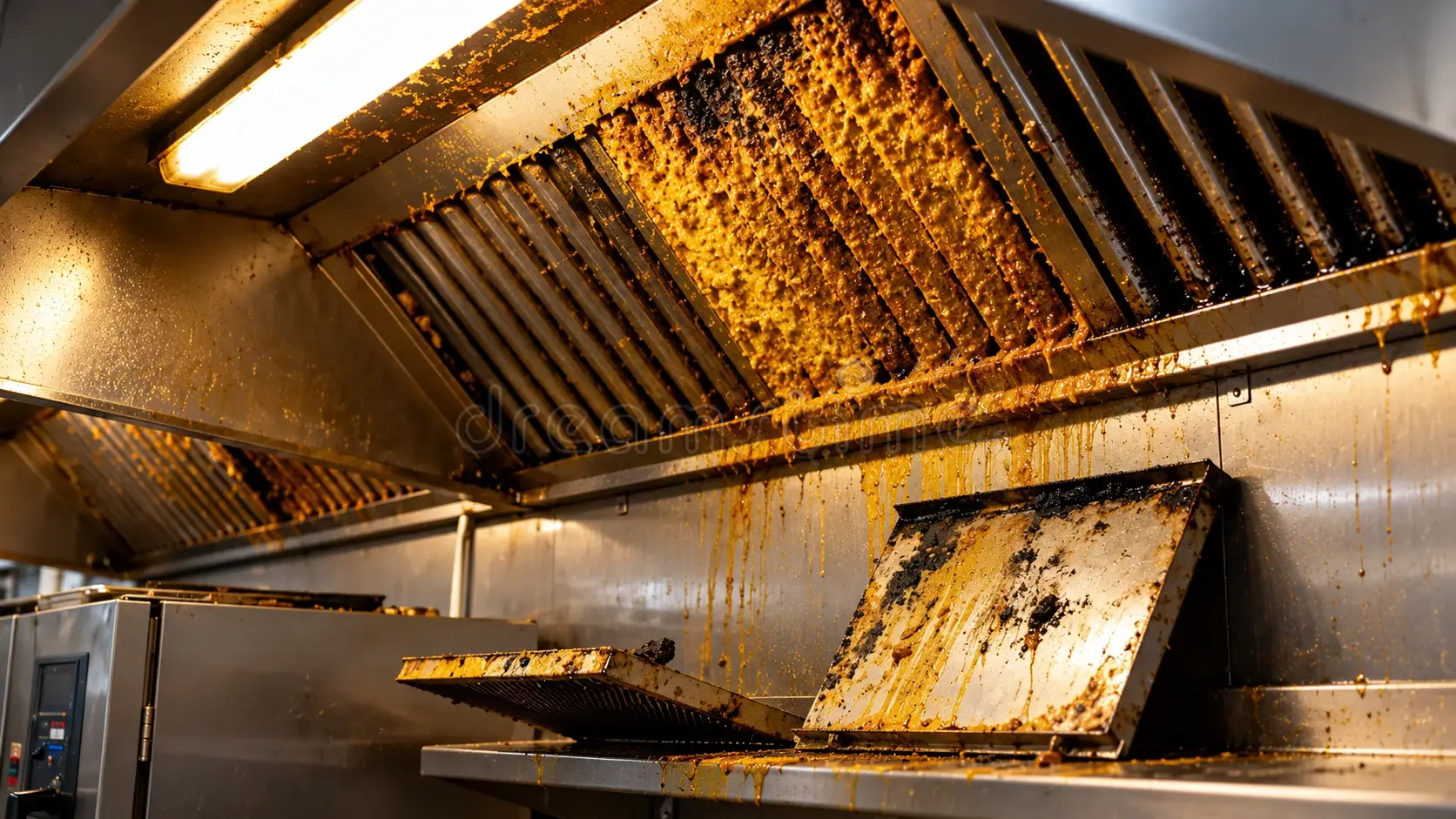
Grease filters sit at the entry point of the commercial hood, between the cookline and the plenum. Their job is to capture as much aerosolized grease as possible before it reaches the plenum and enters the ductwork. Every particle of grease captured at the filter stage is a particle that doesn’t accumulate inside the exhaust system, doesn’t load the fan, and doesn’t reach the rooftop discharge.
Filter capture efficiency varies by filter type and by the physical characteristics of the aerosolized grease — smaller droplets pass through most filter designs, larger droplets get captured at higher rates. No filter captures 100% of airborne grease. That’s why NFPA 96 requires the rest of the exhaust system to be cleaned to bare metal at intervals set by Table 12.4 (see our post on NFPA 96 grease thickness rules for the underlying inspection requirement).
Filter maintenance is the operator’s responsibility under Section 12.4 of NFPA 96 — the daily and weekly cleaning that keeps filters working properly. Filter maintenance is NOT part of the standard NFPA 96 professional service scope, though Facilitec Southwest offers filter cleaning as an optional add-on to recurring service. Our post on commercial kitchen grease filters as the first line of defense covers operator-side filter care in more depth.
BAFLE FILTERS
How common: The vast majority of commercial kitchens use baffle filters
Material: Stainless steel or galvanized steel
Capture method: Centrifugal separation through angled vanes
Maintenance: Remove, wash, drain, and reinstall in original orientation
Baffle filters are the industry standard. They’re constructed from stainless or galvanized steel with a series of angled vanes that force airborne grease to make sharp directional changes. Grease droplets, being heavier than air, can’t follow the direction change as quickly and impact the vanes — where they get captured and drain downward into the hood’s grease trough.
Baffle filters are durable, dishwasher-safe (with commercial degreaser), and last for years with proper care. They’re also flame-resistant in a way media-based filters aren’t, which is why NFPA 96 and UL 1046 recognize baffle filters as the preferred filter type for grease-laden commercial cooking exhaust.
Daily and Weekly Maintenance
• Daily: Visual check for heavy grease loading; wipe accessible surfaces
• Weekly (or more often for high-volume operations): Remove filters, run through commercial dishwasher with degreaser, allow to drain completely, reinstall in original orientation
• Never: Wash filters in the sink where grease can enter grease-trap plumbing; never reinstall wet or dripping filters; never remove filters during cooking operations
Common Signs of Filter Problems
• Visible grease dripping through the filter into the plenum or cookline
• Reduced airflow at the hood (grease loading blocking passage)
• Damaged or dented vanes reducing centrifugal separation
• Filters missing from certain hood positions (all filter slots must be filled)
• Filters reinstalled upside-down or backward, disabling capture
WATER-WASH FILTERS
How common: Institutional kitchens, high-volume chain operations, some hotels and casinos
Material: Stainless steel filters integrated with hood-mounted spray system
Capture method: Baffle-style capture combined with automated hot water and detergent washing
Maintenance: Automated wash cycles on a schedule, plus periodic system inspection
Water-wash hood systems integrate the filter with an automatic cleaning mechanism built into the hood. On a preset schedule (typically nightly or after every service period), the hood system sprays hot water and detergent onto the filter surfaces, dissolving accumulated grease and washing it into a collection drain. The system then rinses and dries automatically.
Water-wash systems reduce the daily and weekly manual filter cleaning workload significantly. Kitchen staff still perform visual inspections and periodic manual verification, but the primary cleaning cycle happens automatically. This is why water-wash systems dominate in institutional kitchens (hospital, university, corporate campus), high-volume chain operations, and other environments where filter maintenance labor is either expensive or hard to reliably schedule.
What Water-Wash Systems Still Require
• Detergent supply and dosing system maintained at manufacturer specifications
• Hot water supply at proper temperature (typically 140-180°F depending on system)
• Spray nozzles clear of grease buildup — periodic manual cleaning required
• Drain lines maintained and free of grease accumulation
• Wash-cycle timing verified against actual operation patterns
• Filter integrity checked periodically — even water-wash filters can be damaged
FIELD NOTE — WATER-WASH DOESN’T ELIMINATE NFPA 96 SERVICE
A common misunderstanding: because water-wash systems clean themselves, some operators assume the exhaust system doesn’t need NFPA 96 professional service. Water-wash cleans the filters. It does not clean the plenum, the ductwork, the exhaust fan interior, or the rooftop discharge. NFPA 96 Section 12.6.1.1 inspection and Section 12.6.5 cleaning to bare metal apply regardless of filter type — water-wash systems still require the full Table 12.4 cadence for the rest of the exhaust system.
CARTRIDGE FILTERS
How common: Specialty applications — high-efficiency requirements, pollution control unit integration, some casino resort operations
Material: Pleated media in stainless steel frame; some designs use aluminum mesh
Capture method: Depth filtration through pleated media plus centrifugal capture
Maintenance: Media replacement on a schedule; some cartridges are cleanable, others are single-use
Cartridge filters use pleated filter media similar to industrial air filtration cartridges. The pleated design provides significantly more surface area than a baffle filter, which increases capture efficiency for smaller grease droplets that would pass through baffle vanes. Cartridge filters are common on installations that feed pollution control units (PCUs) or that face specific air-quality requirements — restaurants under residential floors, casino resort kitchens, and food-court operations inside enclosed malls.
Different cartridge designs have different maintenance profiles. Some cartridges are cleanable through commercial dishwasher cycles similar to baffle filters. Others use single-use media that gets replaced on a schedule set by the manufacturer and cooking volume. Operators should verify which type they have with the equipment manufacturer or the installing kitchen exhaust engineer.
Cartridge Filter Considerations
• Cost per replacement is significantly higher than baffle filter cleaning cycles
• Media saturation happens on a predictable schedule — track and replace on time
• NFPA 96 fire-safety certification varies by cartridge design; verify listing before installation
• Some cartridge designs incorporate UV or ionization technology in the filter housing itself
• Wash-cycle timing verified against actual operation patterns
• Cartridge failure typically shows as reduced airflow rather than visible grease bypass
2. Side-by-Side Comparison
| ATTRIBUTE | BAFFLE | WATER-WASH | CARTRIDGE |
|---|---|---|---|
| Prevalence | Most common | Institutional / high-volume | Specialty applications |
| Capture method | Centrifugal separation | Centrifugal + automated washing | Depth filtration + centrifugal |
| Manual maintenance load | Weekly manual washing | Minimal manual — system inspection | Media replacement on schedule |
| Grease drainage | To hood trough | To integrated drain system | To hood trough (typical) |
| Fire-safety certification | UL 1046 listed | UL 1046 listed as system | Varies by design — verify listing |
| Operating cost profile | Low — labor for weekly cleaning | Higher upfront, lower labor | Higher recurring — media replacement |
| Best fit for | Standard restaurants, hotels, cafeterias | Hospitals, campus dining, high-volume chains | PCU integration, air-quality-critical installations |
None of these filter types replace NFPA 96 professional service on the rest of the exhaust system. Regardless of filter choice, the hood plenum, ductwork, exhaust fan interior, and rooftop discharge all require inspection and cleaning to bare metal on the Table 12.4 cadence.
3. How to Identify Which Filter Type You Have
Kitchen managers who aren’t sure which filter type their hood uses can typically identify it visually with a quick check during a scheduled filter cleaning cycle.
- Look at the filter face. Baffle filters show a series of angled vanes when viewed from the cookline side. Water-wash filters look similar but sit inside a hood with visible spray nozzles above and below. Cartridge filters show a visible pleated media pattern behind a metal grille.
- Check for hood-mounted spray equipment. Water-wash systems have spray nozzles integrated into the hood interior and a wash-cycle control panel typically located near the hood or in a mechanical space. If you see spray nozzles, you have a water-wash system.
- Look for replaceable media indicators. Cartridge filters often have a service-life indicator, replacement date sticker, or manufacturer’s schedule label on the filter frame.
- Ask the installing contractor or hood manufacturer. If the kitchen was recently built or renovated, the hood manufacturer’s documentation identifies the filter type and specifies the maintenance schedule.
- Ask your NFPA 96 service vendor. The Phil Ackland Certified Technician performing recurring service can identify your filter type on the first visit and document it in the location’s compliance file.
Our detailed post on commercial kitchen grease filters walks through the daily and weekly maintenance routine for the most common filter types.
SIGNATURE APPROACH
From Cooktop to Rooftop, our Phil Ackland Certified Technicians document filter type, condition, and maintenance status on every visit — even though filter cleaning itself is the operator’s responsibility. Knowing what’s in place is the first step to a properly maintained system.
4. What NFPA 96 Says About Filters
NFPA 96, 2024 Edition addresses grease filters primarily in Chapter 6 (Grease Removal Devices) and Section 12.4 (Filter Maintenance).
Chapter 6 — Grease Removal Devices
Chapter 6 sets construction and listing requirements for grease filters and other grease removal devices installed in commercial hood systems. Filters must be listed as suitable for commercial cooking exhaust — the UL 1046 standard is the common reference. Filters must be constructed of noncombustible materials, sized to cover the hood opening completely, and installed in the correct orientation (baffle filters have a specific up/down orientation based on the vane angle direction).
Section 12.4 — Filter Cleaning
Section 12.4 assigns filter cleaning responsibility to the kitchen operator on a daily and as-needed basis. The specific interval depends on cooking volume and menu type — high-volume fryer operations may need daily filter cleaning, while lower-volume operations may extend to weekly. The standard’s language reflects the reality that filter maintenance is an operator function, not a service-vendor function.
Interaction with Section 12.6.1.1 Inspection
During the Section 12.6.1.1 inspection performed by a qualified vendor, filter condition is one of the items evaluated. A qualified inspector will document filter type, condition, orientation, and any observed maintenance gaps on the written cleaning report (Section 12.6.15). Operators who receive reports flagging filter issues should treat those observations as compliance items — the standard makes filter maintenance the operator’s job, and the inspector’s observations create a documented record.
5. Common Filter-Related Compliance Gaps
Five patterns account for most filter-related compliance issues Facilitec Southwest sees during first-time Phil Ackland Certified service on established commercial kitchens.
- Filters installed upside-down or backward. Baffle filter orientation matters — the angle of the vanes determines which direction grease drains. Filters flipped during dishwasher cleaning and reinstalled incorrectly disable the centrifugal separation and let more grease reach the plenum.
- Missing filters. A hood with three filter slots must have three filters. Slots left empty (typically because the filter was removed for cleaning and not reinstalled) create air-bypass paths that skip filter capture entirely.
- Damaged filter frames or vanes. Dropped filters, warped frames from thermal stress, and dented vanes all reduce capture efficiency. Damaged filters should be replaced, not repaired.
- Mixed filter types in the same hood. Some operators replace one baffle filter with a cheaper design or a different manufacturer’s product. Mixed filter types create airflow imbalances and inconsistent capture — the whole hood should use matching filters.
- Water-wash detergent supply lapses. Water-wash systems require ongoing detergent supply. When the reservoir empties and doesn’t get refilled promptly, wash cycles run without cleaning agent — the system looks like it’s working but isn’t actually removing grease.
Each of these gaps appears on the Section 12.6.15 written cleaning report when identified during recurring service. Operators can address them directly by staff training, filter replacement, or manufacturer follow-up as needed.
Frequently Asked Questions
What is a grease filter in a commercial kitchen hood?
A grease filter is a device installed at the entry point of a commercial hood that captures airborne grease from cooking vapor before it reaches the plenum and ductwork. Three main types are common: baffle (industry standard), water-wash (automated cleaning systems), and cartridge (specialty applications with pleated media).
What’s the difference between baffle and water-wash filters?
Baffle filters are stainless or galvanized steel with angled vanes that capture grease through centrifugal separation. They require weekly manual cleaning by kitchen staff. Water-wash filters are integrated into hood systems that spray hot water and detergent to clean themselves on a scheduled cycle, reducing manual maintenance but requiring detergent supply and system inspection.
Which grease filter type is most common?
Baffle filters. The vast majority of commercial kitchens in restaurants, hotels, cafeterias, and small institutional settings use baffle filters. Water-wash systems dominate in high-volume institutional settings (hospitals, campus dining, large chains). Cartridge filters are specialty — used in installations with pollution control units or specific air-quality requirements.
Are grease filters covered by NFPA 96 cleaning service?
No. NFPA 96 Section 12.4 makes filter cleaning the operator’s daily and weekly responsibility. Professional NFPA 96 service (performed by Phil Ackland Certified vendors like Facilitec Southwest) covers the rest of the exhaust system — hood plenum, ductwork, exhaust fan, and rooftop discharge — cleaned to bare metal per Section 12.6.5. Filter cleaning is available as an optional add-on service.
How often should baffle filters be cleaned?
Weekly at minimum for most restaurants, more frequently for high-volume operations. High-volume fryer operations may need daily filter cleaning. The specific interval depends on cooking volume, menu type (fryer-dominant menus load filters faster), and operating hours.
Do water-wash systems eliminate the need for NFPA 96 cleaning?
No. Water-wash systems clean the filters automatically but do not clean the plenum, ductwork, exhaust fan interior, or rooftop discharge. NFPA 96 Section 12.6.1.1 inspection and Section 12.6.5 cleaning to bare metal apply regardless of filter type — the full Table 12.4 cadence applies to the rest of the exhaust system.
How do I know which filter type my hood uses?
Look at the filter face during a scheduled cleaning cycle. Baffle filters show angled vanes when viewed from the cookline side. Water-wash systems have visible spray nozzles integrated into the hood interior. Cartridge filters show a pleated media pattern behind a metal grille. The hood manufacturer’s documentation or your NFPA 96 service vendor can also identify the type.
Are baffle filters dishwasher-safe?
Yes. Baffle filters are designed to be cleaned in commercial dishwashers with degreaser. Never wash in a sink where grease can enter the plumbing. Always allow filters to drain completely before reinstalling, and always reinstall in the original orientation — the vane angle determines the direction grease drains.
What happens if a filter is installed upside-down?
Baffle filter orientation matters. Angled vanes drain grease in a specific direction toward the hood’s grease trough. Filters installed backward or upside-down disable the centrifugal separation, let more grease pass through to the plenum, and increase downstream loading on the ductwork.
How does filter maintenance affect fire risk?
Poor filter maintenance lets more grease reach the plenum and ductwork between NFPA 96 service intervals. That accumulated grease is the fuel that lets a cookline flare-up spread through the exhaust system. Filters are the first line of defense — daily and weekly cleaning materially reduces fire risk. See our post on grease duct fires — how they start and how to prevent them.
NFPA 96, 2024 Edition — Chapter 6 (Grease Removal Devices — construction, listing, orientation requirements); Section 12.4 (filter cleaning — operator responsibility); Section 12.6.1 (qualified-person rule); Section 12.6.1.1 (inspection requirement); Section 12.6.5 (cleaning to bare metal); Section 12.6.15 (written cleaning report). UL 1046 is the underwriters listing standard for grease filters for exhaust ducts commonly referenced in commercial kitchen filter specification. Filter capture efficiency and manufacturer maintenance schedules vary by product; operators should reference their specific hood and filter manufacturer’s documentation for equipment-specific guidance. Water-wash system operating temperatures and detergent specifications vary by manufacturer; typical hot water range for commercial water-wash systems is 140-180°F. Cartridge filter media replacement schedules vary by design and cooking volume; single-use and cleanable cartridge designs both exist in the market. IKECA references are to the International Kitchen Exhaust Cleaning Association’s CECS (Certified Exhaust Cleaning Specialist) and CECI (Certified Exhaust Cleaning Inspector) credentials, and ANSI/IKECA C10 industry standard. Phil Ackland Training is an internationally recognized training program for kitchen exhaust system inspection and cleaning. Facilitec Southwest holds Phil Ackland Certification for its technicians and follows NFPA 96 guidelines for cleaning and inspection of grease buildup. Filter cleaning is the operator’s responsibility under NFPA 96 Section 12.4; Facilitec Southwest offers filter cleaning as an optional add-on to recurring NFPA 96 service. This article is an equipment reference, not manufacturer-specific or AHJ-specific advice.