COMPLIANCE & REGULATIONS · FIRE DATA
The economic case for NFPA 96 compliance doesn’t rest on assumption. Decades of NFPA-published structure fire data show consistent patterns in when, where, why, and how commercial kitchen fires happen. Understanding the patterns helps operators, insurance underwriters, and corporate compliance leads make cleaning cadence decisions that reflect actual risk — not tradition.
August 27, 2026 · By Facilitec Southwest
QUICK ANSWER
NFPA-published fire loss data consistently shows that cooking equipment is the leading cause of structure fires in eating and drinking establishments, with grease as the primary fuel in the majority of fires that spread beyond the cooking equipment itself. Property damage runs into the hundreds of millions of dollars annually across commercial kitchen fires nationwide. Peak fire risk falls during operating hours — especially the dinner service window — and most fires start at the cookline before spreading through the exhaust system when grease accumulation provides fuel. NFPA 96 exists because this data has been consistent for decades. Recurring Phil Ackland Certified cleaning that follows Table 12.4 removes the fuel load that lets a manageable cookline flare-up become a building fire.
MULTI-STATE OPERATOR?
Facilitec Southwest delivers Phil Ackland Certified NFPA 96 cleaning across TX, OK, LA, NM, and AR — the recurring service that removes the fuel load fire data has identified as the primary risk factor.
See Our Kitchen Hood Cleaning Service →
1. The Big Picture — What NFPA Data Consistently Shows
The National Fire Protection Association (NFPA) publishes periodic reports on structure fires in eating and drinking establishments, drawing from national fire incident data collected across U.S. fire departments. The reports have documented consistent patterns for decades:
COOKING
Leading cause of structure fires in eating and drinking establishments
GREASE
Primary fuel involved in majority of fires that spread beyond cooking equipment
COOKLINE
Most common ignition location — fryers, char-broilers, ranges
PEAK HOURS
Fires cluster during operating hours, especially peak service windows
These aren’t statistical curiosities. They’re the empirical basis for NFPA 96 as a fire prevention standard. The cleaning cadence in Table 12.4, the “bare metal” outcome standard in Section 12.6.5, the fan hinge kit requirement in Section 8.1.1.1, and the documentation chain in Sections 12.6.10, 12.6.13, and 12.6.15 all exist to address specific patterns the data has consistently shown.
WHY THE DATA MATTERS FOR YOUR BUSINESS
Insurance underwriters price coverage based on aggregated fire loss data. Fire marshals set enforcement priorities based on the same data. Corporate compliance leads justify cleaning budget based on the risk the data documents. Understanding what the data actually shows — not what people assume — is how operators make risk-informed decisions instead of intuition-driven ones.
2. Where Commercial Kitchen Fires Actually Start
NFPA structure fire data consistently identifies cooking equipment as the leading ignition source in eating and drinking establishment fires. Within cooking equipment, ignition points cluster at specific pieces of equipment.
| IGNITION LOCATION | TYPICAL CAUSE | PREVENTION FOCUS |
|---|---|---|
| Deep fryer | Oil overheating past auto-ignition temperature (~600°F) | Temperature control, oil quality management, immediate suppression response |
| Char-broiler / grill | Grease drippings igniting on high-temperature grates | Regular scraping, drip-pan management, exhaust capture |
| Range / stovetop | Cookware fires, ingredient ignition, unattended pans | Staff training, suppression coverage, Class K extinguisher access |
| Solid-fuel cooking (wood, charcoal) | Ember ejection, fuel handling accidents | Monthly inspection cadence under Table 12.4, spark arrestor maintenance |
| Hood plenum | Accumulated grease igniting from cookline flare-up traveling upward | NFPA 96 cleaning to bare metal per Section 12.6.5 |
| Ductwork interior | Accumulated grease igniting from heat transfer or spread | Access panel entry per Section 12.6.4, tag documentation per Section 12.6.10 |
| Exhaust fan | Grease accumulation on fan wheel and housing igniting from motor heat or duct fire spread | Hinge kit access per Section 8.1.1.1, interior cleaning to bare metal |
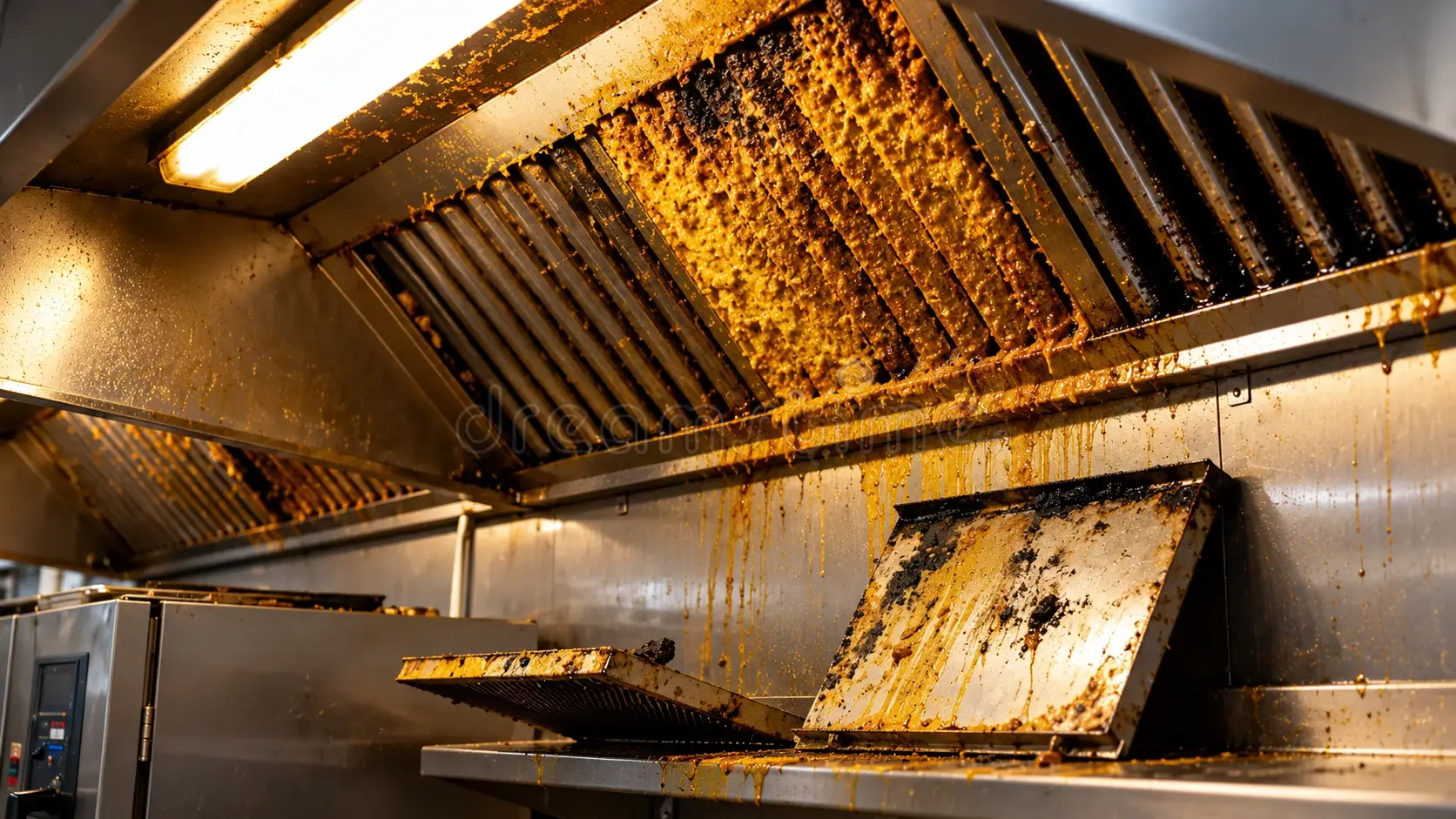
The pattern data shows: most fires start at the cookline, and the ones that grow into significant losses are the ones where grease accumulation elsewhere in the exhaust system provided fuel for spread. Suppression addresses the ignition source. Recurring NFPA 96 cleaning addresses the fuel load. Both matter.
For the deeper mechanical explanation of how a small cookline fire becomes a building fire, see our companion post on grease duct fires — how they start, how they spread, and how to prevent them.
3. When Kitchen Fires Happen
Time-of-day and day-of-week patterns in commercial kitchen fires are among the most consistent findings in NFPA structure fire data. The patterns reflect what you’d expect: fires cluster when kitchens are actively cooking.
Time of Day
Commercial kitchen fires cluster during operating hours, with elevated risk during the peak service windows — typically lunch (11 AM to 2 PM) and dinner (5 PM to 10 PM). Late-night operating hours also carry elevated risk in 24-hour operations. Overnight fires — when the kitchen is closed — are less common but often more damaging when they happen because detection and response take longer.
Day of Week
Weekend service typically drives the highest daily fire volume, reflecting the higher restaurant activity on Friday, Saturday, and Sunday evenings. Special-event days (holidays, gameday weekends in university markets, festival weekends in New Orleans and Lafayette) drive additional concentrated risk in operators serving those events.
Seasonal Patterns
Some geographic markets see seasonal fire pattern variations tied to cooking-volume seasonality — university-town operations during the academic year, seasonal casino resort operations, and hurricane-season response demand in Louisiana and coastal Texas. Facilitec Southwest’s Southwest kitchen exhaust compliance guide covers regional patterns in more depth.
FIELD NOTE — THE OPERATIONAL IMPLICATION
Fires cluster when the kitchen is busy. That’s an obvious observation with a non-obvious operational implication: cleaning cadence should be tightened before high-volume periods, not after them. Restaurants scheduling their annual deep cleaning for January are protecting themselves during the slowest month of the year while running fire risk during peak season. Better practice: schedule recurring service so the kitchen is at its cleanest heading into peak service windows.
4. What Commercial Kitchen Fires Cost
NFPA-published data on structure fires in eating and drinking establishments consistently documents significant property damage nationwide — hundreds of millions of dollars annually across commercial kitchen fires. Individual fire costs vary enormously.
Direct Property Damage
Individual commercial kitchen fires typically produce damage ranging from a few thousand dollars (small cookline incidents contained by suppression) to millions of dollars (fires that spread through the exhaust system into the building structure). Multi-tenant properties see additional damage when fires spread to adjacent spaces.
Business Interruption
Beyond property damage, commercial kitchen fires typically produce weeks or months of business interruption while:
- Fire investigation is completed by the AHJ
- Insurance claim is filed and processed
- Damaged equipment is replaced or repaired
- Exhaust system is professionally cleaned and inspected before return to service
- Fire suppression system is recharged and re-certified
- Any structural damage is repaired to code
- Health department and fire marshal issue return-to-operation approval
Business interruption cost typically exceeds direct property damage in operators with high daily revenue. A moderately busy restaurant losing $5,000-$15,000 per day in revenue during a 30-60 day closure incurs $150,000-$900,000 in interruption cost alone.
Insurance Impact
Fire claims produce documented insurance impact beyond the immediate claim — premium increases at renewal, potential coverage restrictions, and in some cases carrier non-renewal. Multi-location operators see portfolio-level insurance impact when one location’s fire affects the whole book’s underwriting. Our post on what your insurance carrier actually wants to see covers the underwriter perspective in detail.
The Prevention Comparison
Annual NFPA 96-compliant cleaning cost for a typical restaurant — $2,000 to $10,000 depending on cooking volume, hood configuration, and service frequency — is materially less than the direct property damage of a single significant fire, let alone the business interruption or insurance impact. The data supports the economic case for prevention consistently across cooking volume categories.
See our 2026 pricing guide for actual cleaning cost ranges by cooking volume tier.
5. What the Data Says About Prevention Effectiveness
NFPA-published structure fire data alongside insurance industry loss data supports several consistent conclusions about prevention effectiveness.
- Cleaning cadence matters. Operators on recurring compliant service cadences show lower fire loss frequency than operators without recurring service or on extended cadences beyond Table 12.4 guidelines.
- Documented compliance matters at claim time. Operators with complete NFPA 96 documentation chains — service label, access panel tags, written reports — process fire claims faster and with fewer coverage disputes than operators with incomplete or missing documentation.
- Filter maintenance matters daily. Operators with disciplined daily and weekly filter cleaning practices show lower ductwork loading rates, which translates to lower fire risk between scheduled NFPA 96 service visits. See our post on commercial kitchen grease filters as the first line of defense.
- Fire suppression system maintenance matters. Operators with current suppression system inspection and testing show better fire outcomes when ignition happens. Suppression that works reduces the frequency of small fires becoming large ones.
- Fan hinge kit compliance matters. Systems with proper Section 8.1.1.1 hinge kit access can be inspected and cleaned to bare metal at every service. Systems without hinge kits accumulate hidden grease in the fan housing over time, elevating fire risk.
These conclusions aren’t Facilitec Southwest marketing — they’re consistent findings across decades of fire loss data. NFPA 96 exists to codify what the data has consistently shown works.
SIGNATURE APPROACH
From Cooktop to Rooftop, our Phil Ackland Certified Technicians address the specific fuel-load patterns the data identifies as the primary fire risk. The outcome is a Grease-Free and Fire-Safe kitchen and the peace of mind that comes with it.
6. What the Data Doesn’t Say — And What Operators Sometimes Assume
Fire data supports specific conclusions clearly. Operators sometimes extrapolate beyond what the data actually shows, leading to prevention decisions that don’t match the underlying risk.
“We haven’t had a fire, so our cadence is fine.”
Absence of fire history doesn’t confirm current compliance is sufficient. Fires are relatively rare events at any individual kitchen — most operators can go years without an incident even under sub-optimal maintenance. Fire loss data is aggregated across the industry, and prevention decisions should reflect aggregated risk, not individual operating history.
“Our insurance covers it, so we’re fine.”
Insurance covers direct property damage subject to policy terms. It doesn’t cover business interruption in every case, doesn’t cover premium increases at renewal, and doesn’t cover the potential for coverage restrictions or non-renewal. Documented NFPA 96 compliance improves both claim outcome and post-claim underwriting.
“Our staff can spot fire risk.”
Kitchen staff typically don’t have training in identifying combustible deposits inside ductwork, on fan interiors, or behind access panels. NFPA 96 Section 12.6.1 requires the inspection be performed by a properly trained, qualified, and certified person — not because staff aren’t observant, but because the specific evaluation requires specialized training. See our post on DIY vs professional hood cleaning.
“Our building has sprinklers.”
Building sprinkler systems address structural fire spread but don’t extinguish grease fires inside exhaust ductwork. Kitchen suppression systems (Ansul R-102 and equivalents) are the primary response to cookline fires, and even those don’t cover the full ductwork run past the initial section. Sprinklers are supplemental, not primary.
Frequently Asked Questions
What are the most common causes of restaurant fires?
NFPA-published data consistently identifies cooking equipment as the leading cause of structure fires in eating and drinking establishments, with grease as the primary fuel in the majority of fires that spread beyond the cooking equipment. Ignition points typically cluster at fryers, char-broilers, and ranges.
How often do commercial kitchen fires actually happen?
NFPA-published data documents thousands of commercial kitchen fires annually across the United States, with significant year-over-year variation. Fires are rare enough that individual operators can go years without an incident, but common enough that industry-wide losses run into hundreds of millions of dollars annually.
When during the day are kitchen fires most likely?
Kitchen fires cluster during operating hours, with elevated risk during peak service windows — typically lunch (11 AM to 2 PM) and dinner (5 PM to 10 PM). Overnight fires when the kitchen is closed are less common but often more damaging because detection and response take longer.
What’s the average cost of a commercial kitchen fire?
Individual fire costs vary enormously — from a few thousand dollars for small cookline incidents to millions of dollars for fires that spread through the exhaust system into the building structure. Business interruption cost typically exceeds direct property damage in high-daily-revenue operations, and insurance impact continues at renewal.
Does regular hood cleaning actually reduce fire risk?
Yes. NFPA-published data and insurance industry loss data both support the conclusion that operators on recurring compliant cleaning cadences show lower fire loss frequency than operators without recurring service. Recurring cleaning removes the accumulated fuel load that lets a small cookline flare-up spread through the exhaust system.
How much does prevention cost compared to a fire?
Annual NFPA 96-compliant cleaning cost for a typical restaurant runs $2,000 to $10,000 depending on cooking volume and service frequency. Direct property damage from a single significant fire, plus business interruption and insurance impact, typically exceeds this amount by orders of magnitude.
Do sprinkler systems prevent kitchen fires?
Building sprinkler systems address structural fire spread but don’t extinguish grease fires inside exhaust ductwork. Kitchen suppression systems (Ansul R-102 and equivalents) are the primary response to cookline fires. Sprinklers are supplemental.
What’s the leading fuel in commercial kitchen fires?
Grease. NFPA-published data consistently identifies grease as the primary fuel involved in the majority of commercial kitchen fires that spread beyond the ignition point. Recurring NFPA 96 cleaning removes the accumulated grease that would otherwise carry fire from the cookline through the exhaust system.
Why does NFPA 96 require documentation of every cleaning?
Documentation serves two functions: fire marshal verification of ongoing compliance, and insurance carrier evidence at claim time. The documentation chain (Sections 12.6.10, 12.6.13, 12.6.15) exists because the data shows documented operators have better claim outcomes and better ongoing compliance than undocumented ones.
How does Facilitec Southwest help reduce fire risk?
Phil Ackland Certified Technicians deliver NFPA 96 inspection and cleaning on the correct Table 12.4 cadence, address the fuel-load patterns the data identifies as the primary fire risk, and produce the full documentation chain that supports claim response and ongoing compliance. See our <a href=”https://facilitec-sw.com/our-services/kitchen-hood-cleaning/”>Kitchen Hood Cleaning service
SOURCES AND NOTES
Fire loss statistics reference National Fire Protection Association (NFPA) published reports on structure fires in eating and drinking establishments, drawn from National Fire Incident Reporting System (NFIRS) data collected across U.S. fire departments. Specific incident counts, property damage figures, and pattern data vary year over year; general trends referenced in this article reflect consistent multi-year patterns rather than a specific reporting cycle. NFPA 96, 2024 Edition — Section 12.6.1 (qualified-person rule); Section 12.6.1.1 (inspection requirement); Table 12.4 (inspection frequency); Section 12.6.4 (accessibility); Section 12.6.5 (cleaning to bare metal); Section 8.1.1.1 (exhaust fan hinge kit); Section 12.6.10 (access panel service tags); Section 12.6.13 (service label); Section 12.6.15 (written cleaning report). Auto-ignition temperature range for common cooking oils referenced from industry-published values; exact ignition temperature varies by oil type and oxidation state. Cost figures for cleaning services and business interruption reflect industry-typical ranges for commercial kitchens in TX, OK, LA, NM, and AR; individual operator experience varies with cooking volume, hood configuration, and daily revenue. Fire suppression system references reflect standard wet-chemical system design (Ansul R-102 and equivalent Class K suppression). IKECA references are to the International Kitchen Exhaust Cleaning Association’s CECS (Certified Exhaust Cleaning Specialist) and CECI (Certified Exhaust Cleaning Inspector) credentials, and ANSI/IKECA C10 industry standard. Phil Ackland Training is an internationally recognized training program for kitchen exhaust system inspection and cleaning. Facilitec Southwest holds Phil Ackland Certification for its technicians and follows NFPA 96 guidelines for cleaning and inspection of grease buildup. This article is a data-informed compliance reference, not legal, insurance-carrier-specific, or fire-incident-specific advice. In the event of an active fire, activate suppression, evacuate, and call 911.