OPERATIONS & REGULATIONS · HIGHER EDUCATION VERTICAL
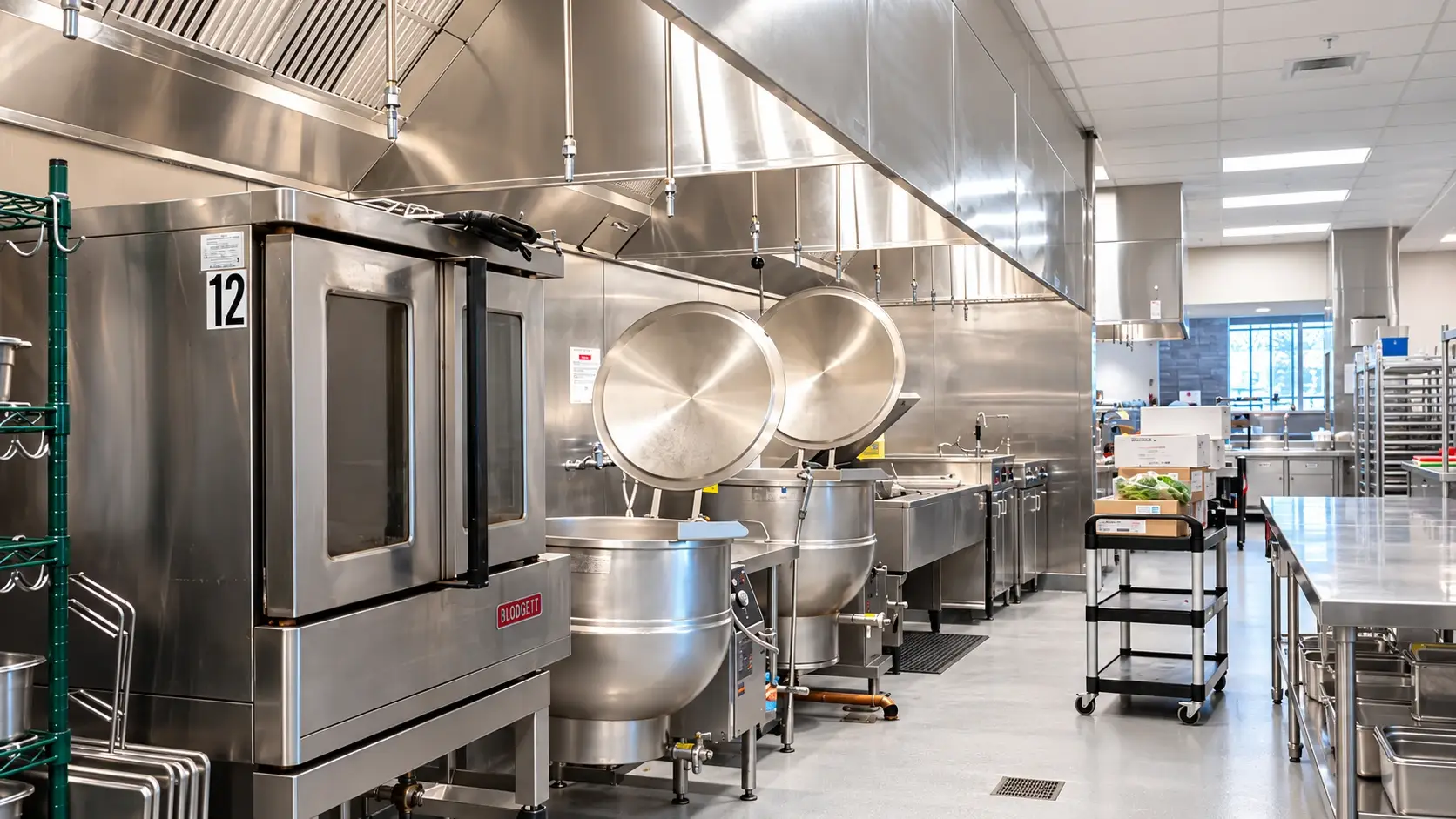
A flagship university runs more commercial kitchens than most restaurant groups — residential dining halls feeding thousands a day, a dozen retail concepts, catering, faculty dining, and a stadium that serves eighty thousand people seven Saturdays a year. Most of it is operated by a contracted foodservice company under a campus dining director who reports to student affairs, not facilities. The compliance picture is closer to a hospital system than a restaurant, with one difference no hospital has: the calendar.
QUICK ANSWER
University and campus dining programs are institutional foodservice operations under NFPA 96 — multiple kitchens across one campus, most on the monthly or quarterly Table 12.4 cadence, typically operated by a contracted company (Chartwells, Sodexo, Aramark) under a university dining director with facilities management holding the building and code responsibility. Three things make campus dining distinct: the academic calendar creates a predictable off-season for deep service and a predictable surge at term start; stadium and arena concessions run at extreme volume for a handful of days and sit idle between, which loads systems in a pattern no other kitchen type sees; and the three-party structure (university, contractor, cleaning vendor) creates documentation gaps unless ownership is explicit. Campus dining programs in TX, OK, LA, NM, and AR should treat NFPA 96 as a portfolio problem with a seasonal schedule.
CAMPUS DINING PROGRAMS
Facilitec Southwest services university dining portfolios across the Southwest — residential halls, retail, catering, and stadium concessions — on an academic-calendar schedule with one documentation file for the dining director and facilities.
See Our Schools & Universities Service →
1. What a Campus Dining Program Actually Is
The phrase “campus dining” undersells the scale. A large public university in the Southwest typically operates:
| KITCHEN TYPE | TYPICAL COUNT | COOKING PROFILE | TABLE 12.4 CADENCE |
|---|---|---|---|
| Residential dining halls (all-you-care-to-eat) | 2–6 | High-volume, multiple cooking platforms, 12–16 hours/day during term | Monthly or quarterly |
| Retail concepts in student unions and academic buildings | 8–25 | Quick-service — grills, fryers, pizza, coffee; some national brands | Quarterly |
| Catering / production kitchen | 1–2 | Event-driven batch cooking; heavy volume on event days | Quarterly |
| Faculty club / conference center dining | 1–2 | Moderate-volume, table service | Semiannual |
| Stadium and arena concessions | 20–60 stands | Extreme volume on event days; idle between | Event-driven — see Section 4 |
| Athletics training table | 1 | High-volume, restricted access | Quarterly |
| Greek housing and residential college kitchens | Varies | Often outside the contracted program; sometimes overlooked entirely | Varies — must be surveyed |
A single campus can have forty to ninety commercial hoods across a dozen buildings, operated by two or three different entities, on three or four different Table 12.4 cadences. That’s a portfolio. The structure from our post on multi-location kitchen compliance applies directly — with a campus-specific calendar on top.
2. The Three-Party Structure
Campus dining almost always involves three organizations with a stake in NFPA 96 compliance. Gaps happen where ownership isn’t written down.
- The university. Owns the buildings and the exhaust systems. Facilities management holds the code relationship with the local fire marshal and the state fire marshal. The dining director — usually in auxiliary services or student affairs — holds the contract with the foodservice operator. These are often two different reporting lines that don’t share a file.
- The contracted foodservice operator. Chartwells Higher Education (Compass), Sodexo, and Aramark run the large majority of campus dining programs in the Southwest. Self-operated programs exist (some universities run their own dining) but are the minority. The contractor operates the kitchens, employs the staff, and usually holds or coordinates the exhaust cleaning contract.
- The exhaust cleaning vendor. Performs the NFPA 96 inspection and cleaning, delivers the documentation, and coordinates access with the contractor’s on-site management and the university’s facilities team.
The same structure exists in hospitals, and the same failure modes apply. Facilities assumes the contractor has it. The contractor assumes the vendor has it. The vendor sends the report to whoever signed the contract. When the fire marshal asks for documentation, nobody has the whole file. Our post on hospital foodservice and NFPA 96 covers the coordination problem in depth; the solution is identical on a campus.
FIELD NOTE — THE CONTRACT TRANSITION
Campus dining contracts turn over — a university moves from one operator to another every five to ten years, often at the start of a fiscal year in July. The outgoing contractor’s cleaning vendor may not be the incoming contractor’s vendor. The documentation file lives with whoever held the contract. If the university’s facilities team doesn’t have its own copy, the compliance history walks out the door with the old operator. Every campus should require that the exhaust cleaning documentation be delivered to facilities directly, regardless of who contracts the vendor.
3. The Academic Calendar as a Compliance Tool
Restaurants run year-round. Hospitals never close. Universities have a schedule that every kitchen on campus follows, and it’s the single biggest operational advantage campus dining has for NFPA 96 compliance.
| PERIOD | KITCHEN ACTIVITY | COMPLIANCE OPPORTUNITY |
|---|---|---|
| Mid-August: move-in and term start | Maximum residential dining volume; retail opens | All systems should be at baseline clean before this week |
| Fall term (Aug–Dec) | Full operation; football gamedays layered on | Monthly/quarterly cadence per Table 12.4; gameday concession service |
| Winter break (mid-Dec–mid-Jan) | Residential halls closed or minimal; retail closed | Primary deep-service window — full access, no operational conflict |
| Spring term (Jan–May) | Full operation; basketball, baseball, spring events | Monthly/quarterly cadence |
| Commencement and summer start | Volume drops sharply after finals | Secondary deep-service window |
| Summer (Jun–Aug) | Reduced operation; camps, orientation, conferences | Access panel retrofits, hinge kit installs, fan repairs, containment work — the projects that need downtime |
The practical implication: a campus program should schedule its heaviest exhaust work — retrofits, repairs, first-time deep cleans on neglected systems — into winter break and summer, and run the Table 12.4 cadence during term. Hospitals would give a great deal for a three-week window when the kitchens are empty. Campuses get two a year.
THE CALENDAR RULE
Everything that needs the kitchen closed happens in December or June. Everything else runs on Table 12.4. Programs that plan this way never have a technician on a ladder during lunch service.
4. Gameday — The Loading Pattern Nothing Else Produces
Stadium and arena concessions are the compliance problem unique to campus dining. A football stadium in the SEC or Big 12 has dozens of concession stands with commercial hoods that run at maximum output for six to eight hours, seven Saturdays a year — and sit cold in between.
Why this breaks the normal cadence logic
Table 12.4 assumes continuous operation at a given volume. A stand that fries for eight hours on a Saturday and then sits idle for two weeks isn’t a “low-volume” kitchen — it’s a high-volume kitchen operating in bursts. Grease deposited on Saturday sits and oxidizes for fourteen days before the next load goes on top. By the end of a seven-game home schedule, the duct has seven layers of hardened grease, none of which was cleaned between events.
The concession cadence
The workable approach across the Southwest’s major programs treats the football season as its own service cycle:
- Pre-season baseline. Every concession hood cleaned to bare metal in late July or early August, before the first home game. Access panels opened, fans tilted, containment serviced, service labels applied.
- Mid-season inspection. After the third or fourth home game, a Section 12.6.1.1 inspection of the highest-volume stands — the fry-heavy ones near the main gates — with cleaning where the inspection finds it necessary.
- Post-season cleaning. After the last home game, full bare-metal cleaning of every stand before the systems sit through the off-season.
- Basketball and baseball. Arena and ballpark concessions follow the same pattern on their own season.
Our post on inspection vs. cleaning covers why the mid-season step is an inspection with cleaning-as-needed rather than a blanket cleaning.
Southwest programs and their gameday scale
| CAMPUS | STADIUM CAPACITY | CONFERENCE | SERVICE AREA |
|---|---|---|---|
| LSU — Tiger Stadium | 102,321 | SEC | Baton Rouge |
| Texas — DKR Memorial Stadium | 100,119 | SEC | Austin |
| Oklahoma — Gaylord Family Memorial Stadium | 80,126 | SEC | Norman |
| Arkansas — Razorback Stadium | 76,212 | SEC | Fayetteville |
| Texas Tech — Jones AT&T Stadium | 60,229 | Big 12 | Lubbock |
| Baylor — McLane Stadium | 45,140 | Big 12 | Waco |
| Louisiana — Cajun Field | 36,900 | Sun Belt | Lafayette |
| New Mexico State — Aggie Memorial | 28,853 | Conference USA | Las Cruces |
FIELD NOTE — THE STAND THAT ONLY OPEN FOR SELLOUTS
Large stadiums have concession stands that open only when attendance crosses a threshold — the upper-deck stands, the ones in the far corners. They might run three Saturdays a year. Nobody thinks about them between games. Their hoods are on the same duct network as the stands that run every game, their fans are on the same roof, and their last cleaning was whenever someone last remembered they existed. A concession compliance program has to inventory every hood in the building, not just the ones with a line out front.
5. Documentation for Three Audiences
Campus exhaust documentation gets read by more parties than a restaurant’s does.
- The local fire marshal — inspects campus kitchens under the city’s adopted fire code, same as any commercial kitchen. See our state-by-state fire code guide.
- The state fire marshal — public universities are state property in most Southwest states, and the state fire marshal’s office often has direct jurisdiction or a parallel inspection role.
- University risk management and the insurance carrier — public universities are frequently self-insured or pooled through a state risk program; their loss-control reviews mirror commercial underwriting. See when insurance requires more than NFPA 96.
- The contracted operator’s corporate compliance — Chartwells, Sodexo, and Aramark maintain their own compliance standards across every campus they operate, and their regional safety teams audit the file.
- University internal audit — public institutions audit auxiliary services contracts, and exhaust compliance documentation is a common audit item.
One file, delivered to facilities and the dining director simultaneously, in the standard NFPA 96 format — service label per Section 12.6.13, access panel tags per Section 12.6.10, written report per Section 12.6.15 — satisfies all five. Our post on what’s in a real NFPA 96 cleaning report covers the documents.
SIGNATURE APPROACH
From Cooktop to Rooftop, our Phil Ackland Certified Technicians run campus dining programs on the academic calendar — deep service in December and June, Table 12.4 cadence during term, a concession cycle built around the home schedule — with one file delivered to facilities and the dining director. The outcome is a Grease-Free and Fire-Safe campus, every building, every season.
6. Common Campus Gaps
- Retail concepts left off the contract. The residential halls are on the schedule. The coffee kiosk in the library, the grill in the rec center, the pizza counter in the engineering building are not. Every hood on campus has to be inventoried.
- Concessions treated as low-volume. A stand that runs seven days a year is put on an annual cadence. It should be on a pre-season / mid-season / post-season cycle.
- Greek housing and residential colleges outside the program. Fraternity and sorority houses with commercial kitchens are often owned by the chapter, not the university, and fall through the gap between university facilities and the contracted operator.
- Documentation delivered to the contractor only. Facilities has no copy. The file leaves when the contract turns over.
- No baseline before term start. The first cleaning of the academic year happens in October instead of August, after two months of maximum volume on a system that sat all summer.
- Deferred retrofits. Access panels and hinge kits that need the kitchen closed keep getting pushed because “we can’t shut down the dining hall” — when the dining hall is closed for three weeks every December.
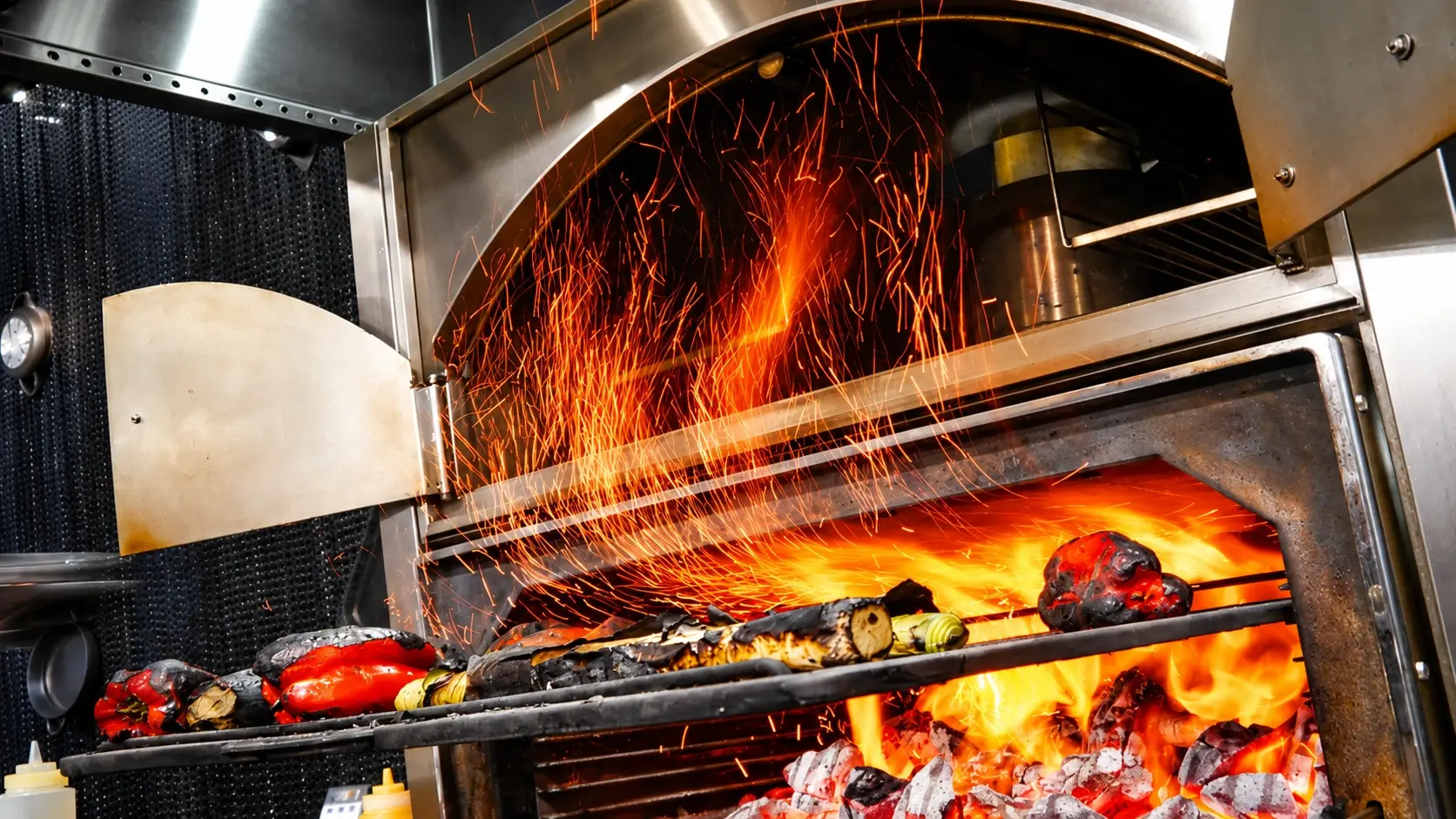
- Solid-fuel concepts added without Chapter 14 review. A wood-fired pizza station in the new dining hall, a smoker at the tailgate concession — see our post on solid-fuel cooking and Chapter 14.
Frequently Asked Questions
Does NFPA 96 apply to university dining halls?
Yes. Campus dining halls, retail concepts, catering kitchens, and stadium concessions are commercial cooking operations under NFPA 96, enforced by the local fire marshal under the city’s adopted fire code and often by the state fire marshal as well, since public universities are state property. Cadence follows Table 12.4 by cooking volume — typically monthly or quarterly for residential dining and quarterly for retail.
Who is responsible for exhaust compliance on a campus — the university or the foodservice contractor?
The university owns the buildings and holds the code responsibility through facilities management. The contracted operator (Chartwells, Sodexo, Aramark, or a self-operated program) runs the kitchens and typically holds or coordinates the cleaning contract. Both need the documentation file. Best practice is written ownership in the dining contract and delivery of every written report to facilities directly, regardless of who contracts the vendor.
How should stadium concessions be scheduled for cleaning?
As their own seasonal cycle, not on the standard Table 12.4 cadence. Pre-season baseline cleaning of every stand before the first home game, a mid-season inspection of the highest-volume stands after the third or fourth game with cleaning as needed, and a full post-season cleaning after the last game. Basketball and baseball concessions follow the same pattern on their seasons.
When is the best time to do exhaust system retrofits on a campus?
Winter break (mid-December to mid-January) and early summer (after commencement). Residential dining is closed or minimal and retail is shut. Access panel installation, hinge kit retrofits, fan repairs, and containment work that require the kitchen offline fit in these windows without operational conflict.
What happens to the compliance file when the dining contract changes operators?
If the file lives only with the outgoing contractor, it leaves with them. The university should require that exhaust cleaning documentation be delivered to facilities management on every service, so the compliance history stays with the institution across contract transitions.
Are Greek houses and residential colleges part of the campus dining program?
Often not. Fraternity and sorority houses with commercial kitchens are frequently owned by the chapter or a housing corporation, not the university, and fall outside both the contracted dining program and university facilities. They still fall under NFPA 96 and the local fire marshal. Campus risk management should know whether they’re covered and by whom.
Why should every kitchen be at baseline before fall term starts?
Move-in week is the highest-volume period of the year for residential dining, and it follows a summer of reduced operation. A system that sat through summer with June’s deposits and then absorbs August’s volume reaches the cleaning threshold fast. Baseline cleaning in late July or early August means the term starts on a clean system and the first Table 12.4 inspection falls at the right point.
Do university kitchens face different fire marshal inspections than restaurants?
The standard is the same — NFPA 96 as adopted through the local fire code. The difference is jurisdiction: public universities are often inspected by the state fire marshal in addition to or instead of the city, and the university’s own risk management and internal audit functions review the documentation. One standard file satisfies all of them.
What about the wood-fired pizza oven in the new dining hall?
Solid-fuel cooking falls under NFPA 96 Chapter 14 — spark arrestor, dedicated exhaust, suppression suited to a fuel bed, fuel storage, ash handling, monthly cadence. A wood-fired station added to a dining hall needs Chapter 14 review, not just a hood over it. See our solid-fuel post.
How does Facilitec Southwest work with campus dining programs?
Full-campus hood inventory including retail, catering, athletics, and concessions. Academic-calendar scheduling — deep service and retrofits in December and June, Table 12.4 cadence during term, seasonal concession cycles around the home schedule. One documentation file delivered to facilities and the dining director. Coordination with Chartwells, Sodexo, Aramark, or self-operated programs. Service across TX, OK, LA, NM, and AR. See our Schools & Universities service.
NFPA 96, 2024 Edition — Section 12.6.1 (qualified person); Section 12.6.1.1 (inspection); Table 12.4 (inspection frequency); Section 12.6.4 (accessibility); Section 12.6.5 (cleaning to bare metal); Section 8.1.1.1 (fan hinge kit); Section 12.6.10 (access panel tags); Section 12.6.13 (service label); Section 12.6.15 (written report); Chapter 14 (solid-fuel cooking). Stadium capacities reflect published figures for the 2026 season and are subject to change with renovation. Conference affiliations reflect 2026 membership. Contracted foodservice operator references (Chartwells Higher Education / Compass Group, Sodexo, Aramark) reflect major providers in campus dining as of 2026; specific campus contracts vary. State fire marshal jurisdiction over public university property varies by state; operators should confirm the applicable AHJ with university facilities and risk management. Academic calendar patterns are typical for Southwest institutions on a semester system; specific dates vary by campus. IKECA references are to the International Kitchen Exhaust Cleaning Association’s CECS and CECI credentials. Phil Ackland Training is an internationally recognized training program for kitchen exhaust system inspection and cleaning. Facilitec Southwest holds Phil Ackland Certification for its technicians and follows NFPA 96 guidelines for cleaning and inspection of grease buildup. This article is a compliance reference, not legal or AHJ-specific advice.